
Religion
Kwara Govt Approves Use of Hijab in State-Owned, Grant-Aided Schools

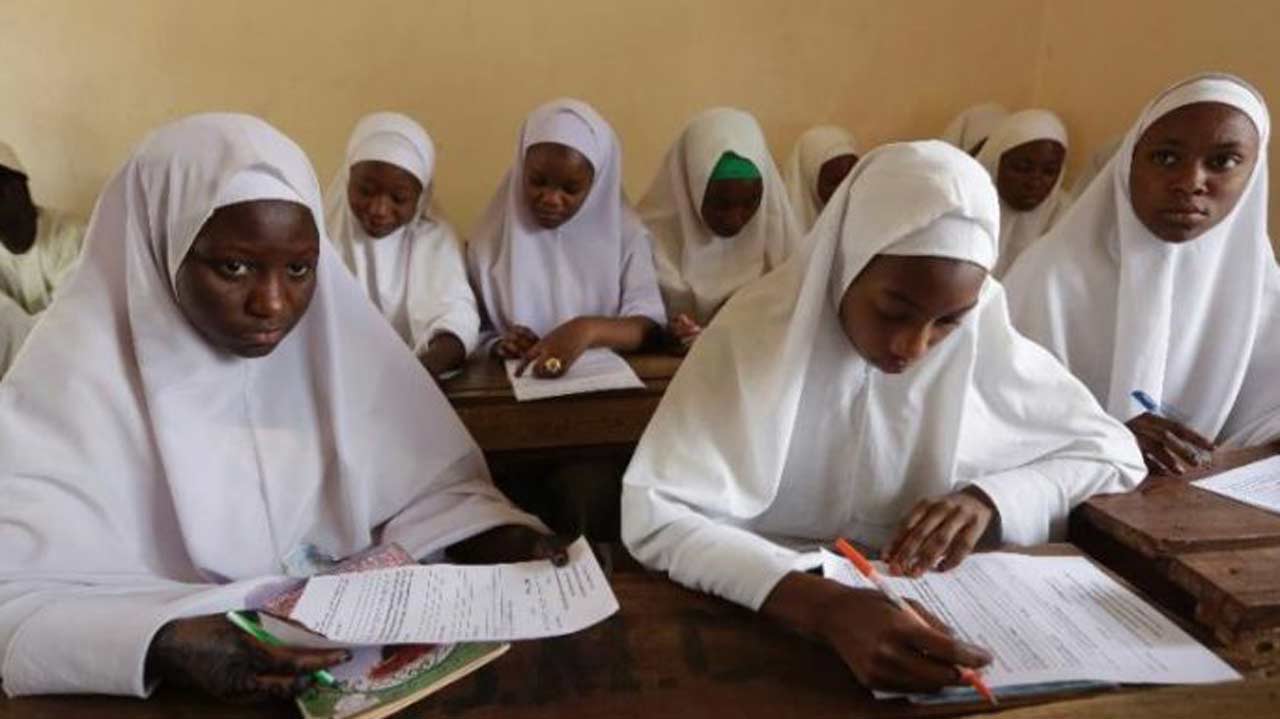
The Kwara Government has approved the use of hijab (veil worn by Muslim women) in state and grant-aided public schools.
This is contained in a statement released by the Secretary to the Kwara Government, Mamma Jibril.
The News Agency of Nigeria (NAN) on Feb.
19 directed the temporary closure of 10 grant-aided secondary schools in Ilorin, pending the resolution of the controversy on the use of hijab.The schools are the C&S College, ST. Anthony College, ECWA School, Surulere Baptist Secondary School, Bishop Smith Secondary School, CAC Secondary School, St. Barnabas Secondary School, St. John School, St.
Williams Secondary School and St. James Secondary School.”The state government has considered submissions of all major interest groups on the matter.
”It has also thoroughly considered the education law of Kwara state, the prevailing court judgments and current global trends of multiculturalism in evolving a consultation-based decision that will bring lasting peace and understanding to our communities.
“The government has also paid particular attention to the ‘declaratory’ nature of the subsisting judgments of the Court of Appeal and their purports.
“Consequently, the government hereby acknowledges and approves the right of the Muslim schoolgirls to wear the hijab, and directs the Ministry of Education and Human Capital Development to come up with a uniform hijab for all public and grant-aided schools, which will be the accepted mode of head covering in schools.
“Any willing schoolgirl with the approved uniform hijab shall have the right to wear same in public/grants aided schools.
“Also, the government affirms the right of every child in public schools to freedom of worship.
“The government hereby directs that the affected 10 schools should reopen to commence classes on March 8.
“Similarly, the government has carefully noted submissions regarding ownership of grants aided schools and related issues.
“While the status of these schools is the subject of judicial determination, this and other related matters will soon be subjected to a technical committee to advise accordingly.
”The government reassures all members of the public that it will act in good conscience at all times.
“The government asserts that there is no victor or vanquished on the hijab question. It urges the two faith communities, especially the leaders, opinion moulders and media personalities to act with restraint and great responsibility in their public utterances and actions, and continue to live in peace and harmony with one another.
“The government commends all the thought and religious leaders on both sides for their forbearance, understanding and commitment to peace”, the statement read.(NAN)






Religion
*Palm Sunday: Show Empathy, Ease Nigerians’ Burden, CAN urges Leaders………laments state of nation
By Laide Akinboade, Abuja
The Christian Association of Nigeria (CAN), at the weekend said in view of the current economic crunch in Nigeria, leaders must not be loud, but be restraints, have empathy and be focused on the common good of the people.
In a statement issued by Archbishop Daniel Okoh,President,CAN, in commemoration of Palm Sunday in Abuja.
The CAN President, lamented about the state of the nation, saying families are feeling the weight of time, cost of living is rising and normal daily lives is getting harder for families.
He said food cost is rising, transportation is high and for many Nigerians is how to stay afloat.
He said it is at this time leaders must make decisions that would ease the pain and burdens of Nigerians.
The statement reads, “As we observe Palm Sunday, we remember a powerful moment. Jesus entered Jerusalem with calm resolve, at a time of uncertainty and expectation. It was not a show of force, but a message of peace, purpose, and hope. In a tense atmosphere, he chose humility; riding on a colt, not in the trappings of power. That choice still speaks to us today.
“Across Nigeria, many are feeling the weight of the times. The cost of living is rising. For countless families, daily life is getting harder. Events far beyond our borders; especially tensions involving Iran, Israel, and the United States, are unsettling global energy markets. The impact is already here. Fuel is more expensive. Transport costs are rising. Food prices are climbing. In moments like this, the calm and clarity of Palm Sunday matter even more.
“For many Nigerians, the concern is simple and immediate: how to cope, how to plan, how to stay afloat. When life feels this uncertain, the tone of national life matters. Words carry weight. Actions have consequences. Palm Sunday reminds us that in tense moments, people need reassurance. They need stability. They need the quiet confidence that those in positions of responsibility understand what they are going through.
“That is why the lesson of Palm Sunday matters for leadership. True leadership is not always loud. It is seen in restraint, in empathy, and in a steady focus on the common good. It is reflected in decisions that ease burdens, calm anxieties, and bring people together. This is a time for such wisdom”.
The CAN boss, therefore urged all Christians in Nigeria, to stand firm on faith, stand together and in peace.
“For the Church and all people of faith, Palm Sunday is also a call to responsibility. It reminds us of a rare moment when people from all walks of life came together with one purpose: to welcome the Messiah in hope, humility, and expectation. That same spirit is needed now. We must stand for peace. We must strengthen unity. We must support one another. In a season that can easily tilt towards tension, we must remain a steady source of light and hope.
“And to every Nigerian, especially the young and those feeling the strain most deeply, do not lose hope. The challenges are real, but they are not the end of the story.
“As we journey through this sacred season, may the spirit of Palm Sunday guide us towards quiet courage, shared purpose, and a renewed commitment to the good of all”, he urged.
Congratulates Muslims on Eid-el-Fitri, urges unity amid economic, security challenges
By Laide Akinboade, Abuja
The Christian Association of Nigeria (CAN), congratulate the Muslim brothers and sisters across the country as they celebrate Eid-el-Fitri 2026.
In a statement issued and signed by
Archbishop Daniel Okoh,President,
Christian Association of Nigeria (CAN), in Abuja
He noted that, Eid marks the end of Ramadan, a period of fasting, prayer, reflection and giving.
He said today Christians in Nigeria celebrate with them, not only the breaking of the fast, but also the strengthening of faith, families and hope.
“At a time like this, our nation needs unity more than ever. From insecurity to economic hardship, the challenges before us are real, but so too is our shared strength. Nigeria works best when we stand together; not divided by faith or ethnicity, but united by a common purpose and a shared future.
“The spirit of Eid; kindness, sacrifice and care for others, offers us a way forward. It calls us to reject division, to choose dialogue over distrust, and to act in ways that heal rather than harm. This is how nations move forward, not just in words, but through everyday actions”, the CAN President, said.
He said, “We join our Muslim compatriots in prayer for Nigeria; for lasting peace, improved security, economic recovery, and leadership guided by wisdom and compassion. We pray that the right values nurtured during Ramadan will endure beyond this season, especially in caring for the poor, protecting the vulnerable, and building a more just society.
“Let this Eid be more than a celebration; let it be a reset for our national conscience”.

A Sokoto-based Islamic scholar, Sheikh Musa Lukuwa, yesterday led his followers in observing Eid al-Fitr prayers in defiance of a directive issued by Sultan Muhammad Sa’ad Abubakar III, who had declared Friday as the official Sallah day.
Lukuwa conducted the two-unit Eid prayer at his Mabera mosque at about 9:10am, hours after the Sultan announced that the Shawwal crescent moon had not been sighted anywhere in Nigeria, thereby extending the Ramadan fast by a day.
In a message circulated on social media, the cleric justified his decision, citing confirmed reports of moon sightings in neighbouring Niger Republic.
“Niger Republic is very close to us about 100 kilometres away.
“If we accept reports from cities like Kano or even Lagos, which are farther away, there is no reason to reject confirmed sightings from a neighbouring country,” ” he said.
He stressed that the action was not intended to undermine the Sultan’s authority but was based on religious conviction.
“We usually follow the Sultan’s directive in starting and ending Ramadan. However, when it is clear that the moon has been sighted, we must act in accordance with the teachings of the Prophet, even if it differs from the Sultan’s declaration,” he stated.
Providing historical context, Lukuwa referenced the era of Abubakar Mahmoud Gummi, when prominent scholars independently announced moon sightings before the responsibility was centralised under the Sultan to ensure unity among Muslims.
He maintained that the Sultan’s decision on this occasion was incorrect.
He reportedly informed congregants around midnight of the development and directed them to assemble for Eid prayers Thursday morning.
In Nigeria, the Sultan of Sokoto, who also serves as President-General of the Nigerian Supreme Council for Islamic Affairs, is the recognised authority for declaring the commencement and end of Ramadan based on verified moon sightings across the country.
His announcements are widely followed to promote unity among Muslims.
However, differences over moon sightings especially when reports emerge from neighbouring countries have occasionally led to divergent observances by some clerics and communities, particularly in northern Nigeria.
This is not the first time Lukuwa and his followers have taken a position at variance with the Sultan’s official declaration, reflecting a broader debate within Islamic jurisprudence on the acceptance of moon sightings beyond national boundaries.


Fresh Terrorists Attack Kills One, Injures Two in Kogi
ShareFrom Joseph Amedu, Lokoja A yet to be identified gunmen suspected to be armed terrorists have attacked two communities in Kogi state killing one resident and injuring two others. The...
Prosperity Cup: Okoroma United Battles Akinima-Biogbo FC in Final Match
ShareFrom Mike Tayese, Yenagoa Akinima/Biogbo FC of Ogboloma in Yenagoa Local Government Area and Okoroma United from Okoroma in Nembe LGA will battle for the ₦30,000,000...

Boko Haram Militants Kill 23 Soldiers in Chad
ShareThe Chadian armed forces on Tuesday said that 23 soldiers were killed and 26 hurt in an attack by Islamist militant group Boko Haram on a base on...


Military Debunks Poor Feeding Claims in North-east
ShareThe Theatre Command North East Joint Task Force, Operation HADIN KAI, has described the poor feeding of troops in operational theatres as misleading. The theatre...


Residents Groan Under Rising Tomato Prices, Seek Alternatives
ShareSome residents in Lagos State have expressed concern over the recent surge in the price of tomatoes, forcing many households to adopt alternatives. The residents made their views known...


Dangote Cement Grows Exports by 71.6 Per Cent, Posts N421bn Profit
ShareBy Tony Obiechina, Abuja Dangote Cement Plc delivered a strong first-quarter performance in 2026, with cement and clinker exports from...


Akume, CAN Rally Faith, Traditional Leaders Towards 2027 Polls
ShareBy Laide Akinboade, Abuja The Secretary to the Government of the Federation, George Akume and the President of the Christian...

FG Unveils $500m Research Fund, Sanctions Honorary Degree Abuse
ShareBy Tony Obiechina, Abuja The Federal Government has approved a sweeping reform package aimed at strengthening Nigeria’s research ecosystem and...
We should not weaponize faith but rather harnessed as a force for peace – CAN
ShareBy Laide Akinboade, Abuja The Christian Association of Nigeria (CAN), on Wednesday, appealed that faith should not be weaponized rather...
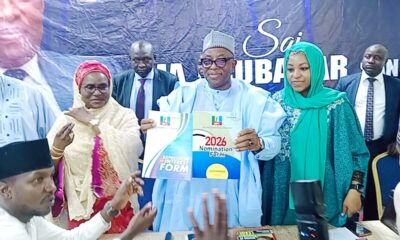

Bauchi Guber: I’ll Serve With Greater Focus, Efficiency Impact – MA Abubakar
ShareBy Mike Odiakose, Abuja Former Bauchi State governor, Mohammed Abdullahi Abubakar, SAN, has assured the people of the state that...