
NEWS
Manufacturing Sector Records Sharp Decline in Tax Remittances

By Tony Obiechina, Abuja
Manufacturers’ Company Income Tax (CIT) payments fell by 68.25 per cent year-on-year to N74.48 billion in the first quarter of 2026, highlighting mounting pressure on Nigeria’s productive sector amid the implementation of new tax laws, weak consumer demand and rising operating costs.
Data from the National Bureau of Statistics (NBS) showed that the manufacturing sector CIT declined by N160.
11 billion from N234.59 billion recorded in Q1 2025. On a quarter-on-quarter basis, tax payments also dropped by 47.49 per cent from N141.84 billion in Q4 2025, representing a decline of N67.36 billion within three months.According to the NBS, which sourced the data from the Nigeria Revenue Service, total Company Income Tax collections stood at N1.37 trillion in Q1 2026, down 8.08 per cent from N1.49 trillion recorded in the previous quarter.
Overall CIT collections also fell by 31.05 per cent year-on-year, indicating a broader decline in company tax receipts across the economy. However, the manufacturing sector’s contraction was significantly steeper than the national average.
Despite the sharp decline, manufacturing remained among the top three contributors to domestic CIT, accounting for 13.82 per cent of domestic collections. The financial and insurance sector led with 24.73 per cent, followed by mining and quarrying at 16.06 per cent.
In value terms, financial and insurance activities contributed N133.27 billion, mining and quarrying paid N86.55 billion, while manufacturing remitted N74.48 billion. When measured against total CIT collections of N1.37 trillion, including foreign currency payments, manufacturing accounted for only 5.45 per cent.
The report further revealed that domestic CIT generated N538.91 billion, while foreign-related tax payments contributed N828.82 billion, representing about 60.6 per cent of total collections during the quarter.
Analysts say the drop in manufacturing tax payments may reflect weaker profitability as companies continue to grapple with high energy costs, exchange rate volatility, expensive borrowing, logistics challenges and declining consumer purchasing power.
The first quarter of 2026 also marked the transition to Nigeria’s new tax framework, which took effect in January, raising questions about whether compliance adjustments, payment timing or shifts in company earnings influenced tax remittances during the period.
The decline extended beyond manufacturing. Agriculture, forestry and fishing recorded the steepest quarter-on-quarter fall in CIT payments at 73.52 per cent, followed by construction with a 63.15 per cent drop.
Conversely, water supply, sewerage, waste management and remediation activities posted the highest quarter-on-quarter growth of 485.71 per cent, while activities of households as employers rose by 197.04 per cent.
The figures suggest that although overall company tax collections remain substantial, they are becoming increasingly reliant on financial services, mining and foreign tax payments, while contributions from key productive sectors such as manufacturing continue to weaken.
Company Income Tax is levied on profits earned by companies operating in Nigeria after allowable deductions and reliefs. Under the new tax reforms signed into law by President Bola Tinubu, the CIT rate was reduced from 30 per cent to 25 per cent.
Minister of Finance and Coordinating Minister of the Economy, Taiwo Oyedele, who previously chaired the Presidential Committee on Fiscal Policy and Tax Reforms, has stated that the reduced CIT rate and the introduction of a zero per cent tax rate for companies with annual turnover of N100 million or less are expected to support small and medium-sized enterprises and improve the business environment.
There have been a number of false dawns when it comes to elections in South Sudan, but the authorities have said the long-delayed first-ever vote will take place in December.
The leaders of the world’s youngest country have not been tested at the ballot box since independence in 2011 and President Salva Kiir has been in office for 15 years.
According to the original plan, the general election was supposed to have happened in 2015 but a civil war meant that had to be postponed.
The 2018 peace deal, which created a unity government with Kiir at its helm and rival Riek Machar as his deputy, envisioned an election in 2022 but the vote was never organised amid tension between the country’s leaders.
Continued issues between the two men could yet delay the vote further.
Machar was sacked as vice-president and arrested earlier last year and charged with murder, treason and crimes against humanity, which he denies. He has been under house arrest in the capital, Juba, since March last year as fighting persists in some areas of the country.
There have been warnings, including form the UN that the violence could once again spill over into full-scale civil war.
When announcing the 22 December date for the vote, electoral chief Abednego Akok Kacuol acknowledged that unresolved legal amendments and persistent funding gaps continued to hamper poll preparations.
“The political will is not ours; it lies with the government,” he said.
Asked what would happen if funds were not secured within six months, Kacuol said his commission would continue planning while adjusting toward a “realistic electoral timeline”.
In a statement on Monday, the presidency said Kiir was committed to implementing the 2018 peace agreement and keeping South Sudan on track toward peaceful, democratic elections.
It said preparations for inter-party dialogue on election-related issues were progressing and would provide a platform for building consensus among political stakeholders.
But opposition groups and civil society organisations have raised concerns over security conditions, political freedoms and electoral readiness.
The Sudan People’s Liberation Movement in Opposition (SPLM-IO), the party of Machar, warned about the poll preparations, saying holding elections remained a “dangerous” matter.
“Anyone coming to register voters and campaign in territories controlled by the mighty SPLM-IO, you will be a prisoner of war,” Nathaniel Pierino, acting chairperson of the group, said in a post on Facebook.
“Be reminded, the country is at war,” he added.
By Eze Okechukwu, Abuja
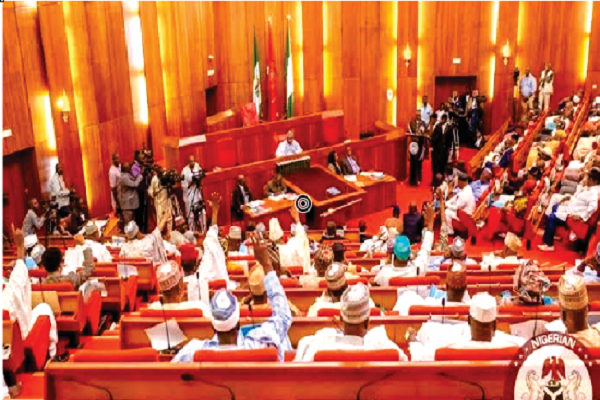
The Senate has scheduled amendments to the 1999 Constitution to provide for the establishment of State Police in the country, with an indication that it will be transmitted to the 36 State Houses of Assembly for further legislation.
The leader of the Senate, Senator Opeyemi Bamidele, in a statement yesterday said all stakeholders across the federation “are on the same page with the National Assembly on the establishment of State Police.
”Bamidele explained that the National Assembly would isolate the aspect from the ongoing constitution amendment and pass it into law due to its national exigency.
He also revealed that President Bola Ahmed Tinubu and all the state governors were on the same page with the national assembly on the state police, adding that the legislative week, which begins today, would be a crucial one for the Senate as the issue of state police would top their agenda.
“Our position is very clear on state police. We are standing with Nigerians on the issue of state police. All strata of the federation have made it clear that there cannot be a better time to establish a state police than now.
“That is where we stand. Where we are coming in is to now help translate this popular desire of the people into reality as elected representatives of the Nigerian people.
“We came to the conclusion that we are going to pass the constitutional amendment in this respect to make a provision for the state police. If I can tell you as of today, that will come to fruition this very week because there is no need to allow any further delay
“There have been a series of meetings between the National Assembly. When I say the national assembly, I mean Chairman, Senate Committee on the Review of the 1999 Constitution, Senator Barau I. Jibrin and Chairman, House of Representatives Committee on the Review of the 1999 Constitution, Rt. Hon. Benjamin Kalu, both of whom are representing the National Assembly.
“They had been in a series of meetings with the office of Attorney-General, Chief of Staff to the President, Rt. Hon. Femi Gbajabiamila; Inspector-General of Police, Mr. Tunji Disu and other stakeholders in the last one week and that is why I can sit here to tell you that we’re pursuing that this week.
“It is going to be the subject we will be dealing with this week. What we have resolved to do is to isolate it with the rest of the bills that we have proposed under constitutional amendment so that we can vote on this as soon as possible.
“The bill can as well be on its way to the 36 States House of Assemblies as soon as possible because you know we will need two-third of the state assemblies to approve it before the president can assent to it.
“The president is also with us on this proposal. I am sure he cannot wait for the bill to come to him for assent. I am sure the majority of our governors as we know are in support of this bill. The state assemblies are also waiting for this bill to come. We will initiate the proposal for the creation of state police within the week”, he said.
Gbajabiamila had disclosed that President Tinubu would receive a comprehensive report on the proposed creation of state police as consultations on the constitutional framework for its establishment approached completion.
NEWS
OPay Partners 3MTT, Extends National Innovation Challenge Deadline to Reach More Student Innovators
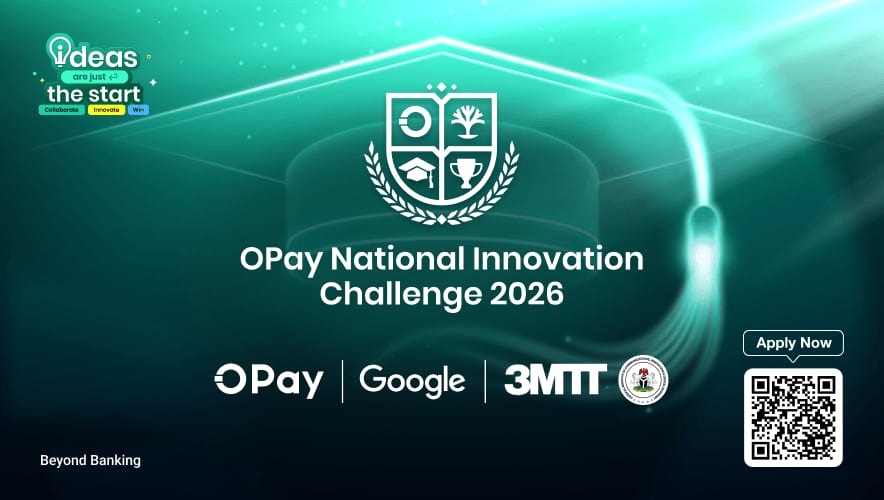
OPay, a leading fintech company in Nigeria, has announced an extension of the application deadline for the National Innovation Challenge, a flagship component of the newly expanded OPay Scholars Programme 2026, from June 14 to July 3, 2026.
The extension follows overwhelming interest from tertiary institution students across the country and numerous requests from prospective applicants seeking additional time to complete and submit their entries.
Students in tertiary institutions across Nigeria can still apply now as a team of five students via https://www.opayweb.com/innovation-challengeThe OPay Scholars Programme is an expanded education and talent development platform designed to empower the next generation of Nigerian innovators, leaders, and problem-solvers. The programme builds on OPay’s landmark N1.2 billion, 10-year scholarship commitment to tertiary institutions across Nigeria and now consists of three key pillars: the N1.2 billion 10-Year Scholarship Programme, the National Innovation Challenge, and OPay Futures, a career and employability development initiative.
In a further boost to the programme, OPay has also entered into a strategic partnership with the 3 Million Technical Talent (3MTT) Programme, the Federal Government’s flagship digital skills initiative under the Federal Ministry of Communications, Innovation and Digital Economy.
The partnership reflects a shared vision between OPay and 3MTT to create meaningful social value by developing Nigeria’s next generation of innovators and expanding access to economic opportunities. Through skills development, innovation, mentorship, and employability pathways, both organisations are committed to supporting the broader goal of creating one million jobs and connecting young Nigerians to opportunities within the rapidly growing digital economy. The collaboration demonstrates how public-private partnerships can accelerate talent development at scale while ensuring more young people are equipped with the skills needed to compete and thrive in a global marketplace.
Through this collaboration, 3MTT will work alongside Google to co-deliver training during the webinar and bootcamp phases of the National Innovation Challenge, while also helping expand awareness of the programme across its nationwide network of fellows and communities.
“At OPay, we believe talent is one of Nigeria’s greatest assets. Through the OPay Scholars
Programme, we are not only investing in education but also creating pathways that connect young people to innovation, employability, and long-term economic opportunity. Our partnership with 3MTT reflects a shared commitment to developing world-class talent, supporting job creation, and ensuring more Nigerians can access opportunities in the digital economy,” said Itoro Udo, Corporate Social Responsibility (CSR) Manager, OPay. “The response to the National Innovation Challenge has been exceptional, and extending the application deadline to July 3 ensures that even more students across the country can participate, showcase their ideas, and benefit from the training, mentorship, and opportunities available through the programme,” he continued.
Commenting on the partnership, Francis Sani, Programme Director, 3MTT said: “Our mission is to build technical talent at scale and create clear pathways from learning to earning. Our collaboration with OPay brings together the strengths of government and the private sector to equip young Nigerians with future-ready skills, expose them to real-world innovation challenges, and improve access to employment opportunities. This partnership aligns closely with our broader vision of developing a globally competitive workforce and creating job opportunities through digital skills, innovation, and talent acceleration. Together, we are helping more young Nigerians move closer to meaningful careers and economic participation.”
Through the expanded OPay Scholars Programme, OPay continues to demonstrate its long-standing commitment to investing in Nigeria’s future through education, innovation, and talent development. By bringing together the N1.2 billion scholarship initiative, the National Innovation Challenge, OPay Futures, Google, and now 3MTT, the programme is creating a comprehensive ecosystem that equips young Nigerians with the skills, credentials, exposure, and opportunities needed to succeed locally and compete globally.
The application deadline for the National Innovation Challenge is now July 3, 2026.
Interested students are encouraged to take advantage of the extension and submit their applications before the new deadline.Apply now via https://www.opayweb.com/innovation-challenge
For more information, visit www.opayweb.com and follow OPay on LinkedIn, @OPay_NG on X, and @opay.ng on Instagram for updates.
About OPay
OPay was established in 2018 as a leading fintech company in Nigeria with the mission to make financial services more inclusive through technology. The company offers a wide range of payment services, including money transfers, bill payments, card services, airtime and data purchases, and merchant payments, among others. Renowned for its fast and reliable network and strong security features that protect customers; funds, OPay is licensed by the CBN and insured by the NDIC with the same insurance coverage as commercial banks.




Customs Intensify Fight Against Smuggling, Seize N273m Prohibited Imports in Cross River
ShareBy Tambaya Julius, Abuja The Nigeria Customs Service has intercepted prohibited imported goods with a Duty Paid Value (DPV) of...


FCDA Indigenous Contractors Protest over Unpaid Fees in Abuja
ShareBy Raphael Atuu, Abuja Concerned indigenous contractors of the Federal Capital Development Authority (FCDA) on Monday staged a protest in Abuja over alleged non-payment for services rendered to the Federal Capital...


Gala Reject €125m Offer for Osimhen
ShareGalatasaray have rejected a bid of €125 million for Super Eagles striker Victor Osimhen, reaffirming their determination to hold onto the Nigerian forward...
South Sudan Sets December for Long-delayed First-ever Election
ShareThere have been a number of false dawns when it comes to elections in South Sudan, but the authorities have said the long-delayed first-ever vote will take...
Terrorism: Lawyers Differ on Rehabilitation, Reintegration Policy
ShareSome legal practitioners in the country have continued to express divergent views on the best approach to handling the rehabilitation and reintegration of repentant...


Senate to Consider Bill on State Police This Week, Says Bamidele
ShareBy Eze Okechukwu, Abuja The Senate has scheduled amendments to the 1999 Constitution to provide for the establishment of State Police in the country, with an...

OPay Partners 3MTT, Extends National Innovation Challenge Deadline to Reach More Student Innovators
ShareOPay, a leading fintech company in Nigeria, has announced an extension of the application deadline for the National Innovation Challenge,...


Wema Bank Boosts SME Growth, Lands €50m EIB Funding
ShareBy Tony Obiechina, Abuja Wema Bank has secured a €50 million financing facility from EIB Global, the development arm of...


US Names Nigerian Suspect, Three Firms in ISIS Financing Sanctions
ShareBy David Torough, Abuja Nigeria’s security challenges came under renewed focus on Tuesday as the United States sanctioned a Nigerian...

Tinubu Courts Global Investors, Backs Digital Future for Nigerian Youths
ShareBy David Torough, Abuja President Bola Ahmed Tinubu has assured global investors that Nigeria’s youthful population is equipped with the...