
BUSINESS
Nigeria Can’t Build $1trn Economy without Women’s Participation – Shettima

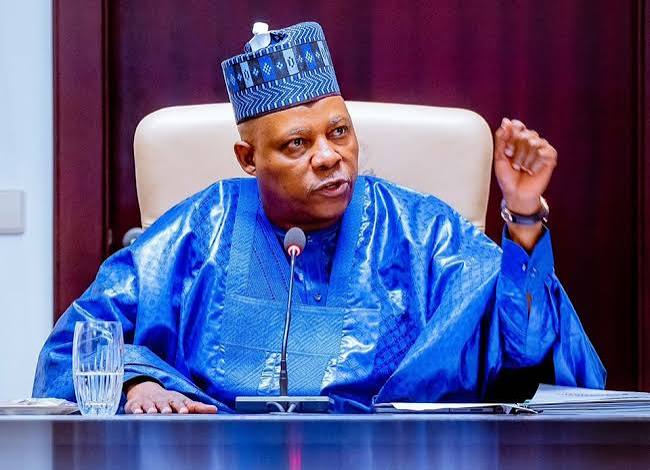
Vice-President Kashim Shettima says Nigeria’s ambition to build a one-trillion-dollar economy cannot be achieved without the full economic participation of women.
Shettima said this on Wednesday in Abuja during the Second National Gender Inclusion Conference, #SheIsIncluded 2026, held at the conference hall of the Presidential Villa.
The vice-president was represented by the Special Adviser to the President on Special Duties, Dr.
Aliyu Modibo.The conference, organised by the Presidential Committee on Economic Inclusion in the Office of the vice-president, was themed, “Designing for Delivery: From Financial Inclusion to Economic Transformation for the Nigerian Woman”.
Shettima insisted that the one-trillion-dollar economic ambition of President Bola Tinubu’s administration would not be achievable without women’s participation in the nation’s economy.
“We have set our sights on a one-trillion-dollar economy. But what kind of economy can we build if half of our people cannot participate fully in creating it?” he said.
The vice-president outlined measures to move women from financial exclusion to productive economic participation.
He said only 47 per cent of Nigerian women had formal financial accounts, compared with 58 per cent of men.
Shettima described the disparity as millions of women whose businesses lacked access to affordable capital and whose entrepreneurial potential remained largely untapped.
He said evidence showed that Nigeria’s economic output could be significantly higher if women participated equally in the economy.
He insisted that investing in women was a growth strategy, not an act of charity.
“The question is no longer whether we can afford to invest in women; it is whether we can afford not to. Our answer is no!” he declared.
He said the federal government was moving from policy declarations to an “architecture of delivery” through initiatives designed to connect women and young people to skills, capital and markets.
Shettima cited the National Income Activation Initiative and the Women in Energy Partnership with the World Bank, among the initiatives.
According to him, it is positioning women to participate as entrepreneurs, engineers, investors and leaders in the energy transition.
Shettima, however, cautioned against measuring progress through national averages alone, saying aggregate figures could conceal the continued exclusion of women in rural communities.
He challenged policymakers and programme implementers to identify who was being reached, who remained excluded, what interventions were working and who should be held accountable when programmes failed.
“That is the difference between announcing inclusion and governing for it,” Shettima said.
He urged financial institutions, fintech companies, investors and development partners to treat gender-intentional finance as a viable market rather than concessionary charity.
“Women’s enterprises are demand; their savings are capital; their ideas are innovation,” he added.
He challenged state governments to measure success not merely by the number of women enrolled in programmes but by businesses expanded, jobs created and households whose resilience improved.
“Inclusion must be measured by changed lives, not attendance registers,” he said.
The vice president also demanded stronger accountability, insisting that every commitment from the conference should have an owner, a measurable target and a deadline.
He said successful interventions should be tracked, reviewed and scaled through mechanisms including the proposed National Gender and Financial Inclusion Awards.
Earlier, the Minister of Women Affairs and Social Development, Imaan Sulaiman-Ibrahim, affirmed that one-trillion-dollar ambition would remain incomplete unless women were fully integrated into the economic transformation agenda.
Sulaiman-Ibrahim identified poor last-mile delivery, unsuitable lending models, inadequate gender-disaggregated data, insecurity and unpaid care work as major barriers to women’s economic participation.
The minister disclosed that the Nigeria for Women Programme Scale-Up had expanded its women’s affinity-group model to 4.5 million women organised into 300,000 groups nationwide.
She said under the first phase, more than 560,000 women were mobilised into over 26,000 groups, saving more than N4.9 billion of their own resources and accessing about N15.6 billion in livelihood grants.
For his part, Technical Adviser to the President on Economic and Financial Inclusion, Dr Nurudeen Zauro, provided a clear outline of the government’s new delivery strategy.
Zauro announced four platforms aimed at transforming financial inclusion into measurable economic participation.
He identified the platforms as digital trust infrastructure, data for accountability, blended finance and the National Income Activation Initiative.
Citing Economic and financial inclusion data, Zauro said Nigeria’s overall financial inclusion rate stood at 74 per cent of adults, but a nine-percentage-point gender gap persisted.
According to him, the disparity in formal access stood at 11 percentage points.
He said the challenge was no longer simply getting women to open bank accounts, but ensuring that access translated into affordable credit, productive finance, enterprise growth and increased income.
“A woman may hold an account and still lack affordable credit; receive a loan and lack a market; own a business and lack the records or collateral to scale it.
“Access is the beginning of inclusion; it is not its destination,” he said.
The high point of the open-day session was the unveiling of the National Income Activation Initiative, delivered in partnership with the Federal Ministry of Women Affairs.
It is an initiative aimed at converting inclusion into income through skills acquisition, markets, digital tools, finance and business support.
Also, Dr Zauro led the Vice President and other dignitaries to the exhibition centres showcasing the innovations of the ShesIncluded initiative. (NAN)
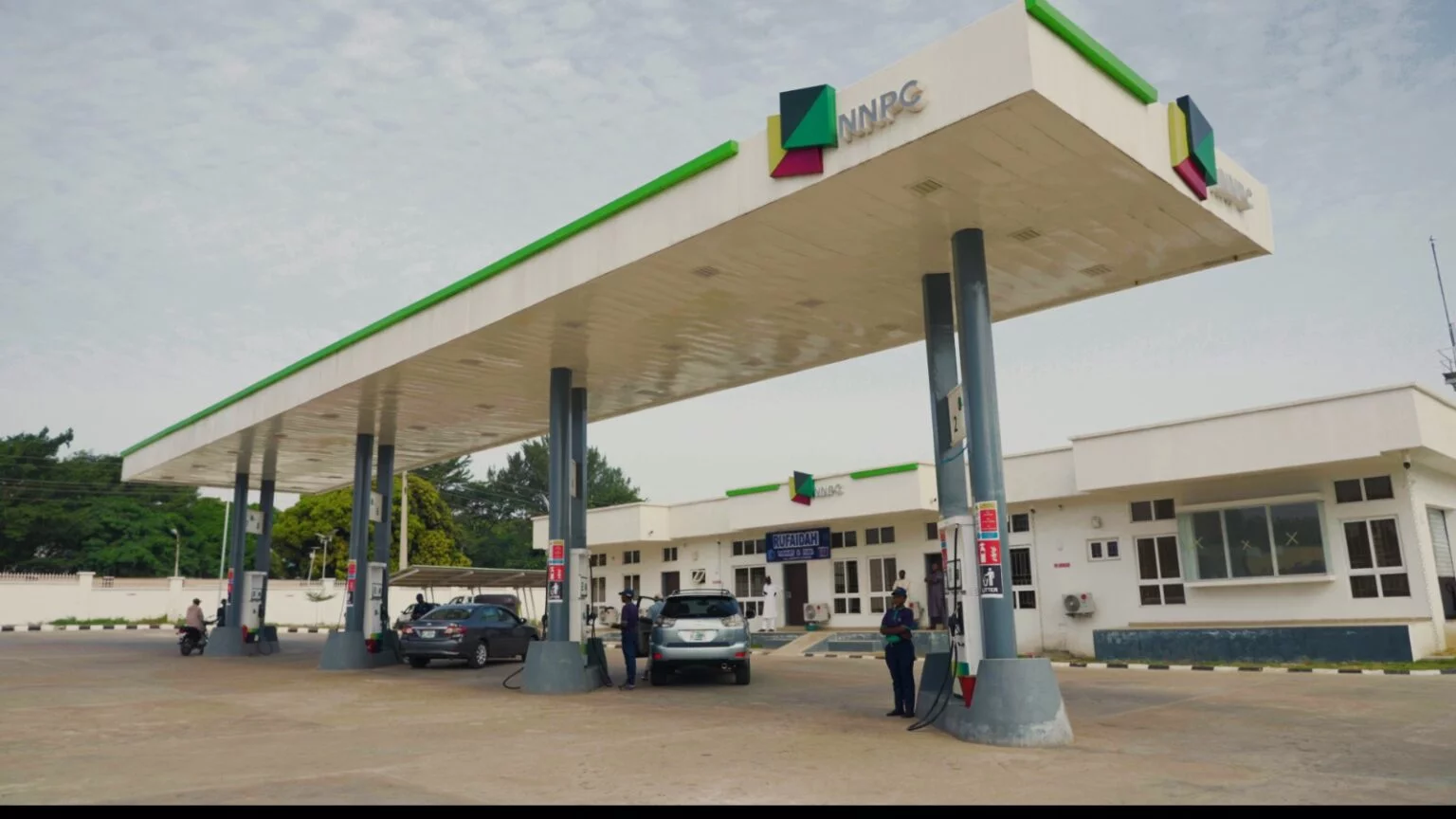
The Group Chief Executive Officer (GCEO), Nigerian National Petroleum Company (NNPC) Ltd., Bashir Ojulari, has urged PENGASSAN to strengthen regulatory discipline to promote stability and growth in Nigeria’s oil and gas sector.
Ojulari made the call on Wednesday in Abuja at the opening of 2026 Petroleum and Natural Gas Senior Staff Association (PENGASSAN) Energy and Labour Summit (PEALS 2026).
The summit, organised by PENGASSAN, is themed, “Strengthening Regulatory Frameworks as a Catalyst for Stability and Growth in Nigeria’s Oil and Gas Industry.
”Ojulari said effective regulation depended on professionalism, governance and accountability.
“A regulatory framework, however well written, is only as strong as the people who apply it every day.
“So, before we speak of frameworks and policy, we must speak of the people who give them life.
“Our people remain our most important asset, and the professionals represented by PENGASSAN contribute daily to our operations, our safety record, our governance and our national energy security,” Ojulari said.
He said PENGASSAN members contributed significantly to industry operations, safety, governance and national energy security, stressing that NNPC Limited remained committed to building a people-centred organisation where employees could thrive.
Ojulari said the company’s values, including enterprise-first mindset, execution excellence, profitable growth and partnership, depended on how employees were treated, motivated and engaged.
He urged industry stakeholders to base decisions on facts, sound governance and established rules, while protecting the long-term interests of their organisations, the sector and nation.
“Are we challenging waste, indiscipline and recklessness wherever they threaten the stability and growth of our sector?” he asked.
He, therefore, stressed that regulatory discipline should become a shared standard nationwide.
The GCEO said sectoral stability required effective regulation and enforcement, as well as a valued and fairly treated workforce, adding that NNPC Limited was improving its employee value proposition.
He urged PENGASSAN leaders and members to engage government and industry stakeholders constructively, while keeping workers’ welfare and dignity central to engagements and policy discussions affecting the sector.
He said Nigeria’s oil and gas industry would thrive when strong regulatory frameworks were matched by disciplined execution, responsible conduct and trusted partnerships across all levels of operations.
Ojulari reaffirmed the organisation’s commitment to working with PENGASSAN and other stakeholders to promote stability, growth and sustainable development across Nigeria’s oil and gas industry.
Also speaking, the Minister of Labour and Employment, Dr. Muhammad Dingyadi, called for robust regulatory frameworks to promote stability, investor confidence and growth in Nigeria’s oil and gas industry.
Dingyadi said strong regulations were essential for responsible resource management, workers’ protection and improved competitiveness, stressing that stable labour relations remained critical to stability in the sector.
“Strong regulatory frameworks are the bedrock upon which stability, investor confidence and equitable growth are built,” Dingyadi said.
Dangote Cement Plc, Obajana, has marked International Youth Day with a renewed commitment to advancing youth development through its array of empowerment programmes, while strengthening its positive social impact.
A statement issued by the company’s Corporate Communications Department said the event attracted more than 100 participants, comprising Sustainability Champions, graduate trainees, management trainees, NYSC Corps members and other invited guests.
The statement said the event served as a platform for young people to showcase innovative ideas, exchange knowledge, and explore practical solutions to sustainability and workplace challenges.
Presentations focused on topics ranging from recycling and environmental sustainability to technology-driven solutions such as the use of drones to enhance safety in mining operations.
The Head of Human Assets Management (HAM) & Administration, Adeniyi Azeez, commended the participants for their creativity and enthusiasm.
He encouraged the youths to continue developing their skills, embrace innovation, and take advantage of opportunities that support their growth and career development.
Also addressing participants, the Head of Social Performance, Ademola Adeyemi, emphasized the importance of youth involvement in shaping a sustainable future.
He urged young people to remain passionate about sustainability, community development, and responsible leadership, noting that today’s ideas can become tomorrow’s impactful solutions.
The programme featured innovation pitches, sustainability-focused presentations, poetry, music performances, games, and interactive sessions that kept participants engaged throughout the event.
A documentary highlighting previous International Youth Day activities also inspired participants and reinforced the value of youth participation in driving positive change.
Participants described the event as inspiring and impactful, citing improvements in their confidence, public speaking abilities, and commitment to advancing sustainability initiatives within their communities.
The statement said the successful celebration of International Youth Day 2026 shows Dangote Cement Plc commitment to youth empowerment, innovation, and sustainable development.
It added that the event demonstrated that when young people are provided with the right platform and encouragement, they can develop practical solutions and become active contributors to a more sustainable future.
The Federal Government has called for the removal of structural barriers limiting women’s leadership in the green economy, while calling for more access to capital, technology and markets.
The Minister of Regional Development, Abubakar Momoh, made the call on Tuesday at the Women’s International Green Summit and Exhibition (WIGSE-26) in Lagos.
Momoh, represented by Dr Okodugha Dauda, Vice President, Corporate Services, Nigerian Society of Engineers for the 2026 executive committee term, said women were already driving innovations in renewable energy, climate-smart agriculture, recycling and clean cooking.
He said the government must move beyond inviting women to participate in the green transition and create conditions that would enable them to lead it.
“Our responsibility is not simply to invite women into the green transition. It is to remove the structural barriers that prevent them from leading it,” he said.
The minister said innovation could not thrive without supportive policies, while meaningful inclusion required deliberate institutional action and sustainable impact depended on access to capital.
He said the green economy must create opportunities for women to own enterprises, control productive assets and participate fully in economic development.
According to him, the transition should generate jobs, strengthen food security, expand energy access, improve public health and build resilient communities.
Momoh said the Ministry of Regional Development would promote gender inclusion, environmental sustainability and climate resilience across its programmes.
He said regional development should go beyond roads and physical infrastructure to encompass human resilience, local economies, ecosystems and livelihoods.
The minister cited solar-powered streetlights installed across Niger Delta communities as an example of interventions that had improved mobility, extended commercial activities and enhanced security.
He said the interventions were particularly beneficial to women traders and small businesses whose operations were constrained by inadequate electricity.
Momoh also highlighted programmes supporting women through entrepreneurship, agriculture, international trade, skills development and access to markets.
He said the Niger Delta Agricultural Development Investment Fund could help women transition from subsistence farming to commercially viable, climate-smart value chains.
The minister said regional development commissions were also supporting women and youths through empowerment, agriculture, livelihood restoration and community resilience programmes.
He said the ministry would deepen collaboration with government agencies, financial institutions, development partners, private organisations and civil society to expand opportunities for women.
Momoh said the ministry was ready to work with WIGSE organisers to translate summit resolutions into practical partnerships capable of creating sustainable livelihoods, resilient communities and investable women-led green enterprises.
He cautioned that the green economy must not become another sector where women provide informal labour while ownership, technology and capital remain concentrated elsewhere.
The President of the Women in Renewable Energy Association (WIRE-A), Dr Anita Nana-Okuribido, identified inadequate finance as the biggest barrier to women’s participation in the energy transition.
“Number one barrier is finance. Without finance, honestly, we cannot go into energy transition,” Nana-Okuribido said.
She also identified tradition and weak implementation of policies as major obstacles to women’s participation in the green economy.
Nana-Okuribido urged policymakers to give women a voice in decisions on energy, climate policy and green investment.
“Inclusion is making sure that the woman has a voice in the decision-making of the green space,” she said.
She said solar power could provide sustainable electricity to rural health facilities and support critical services, including medicine storage.
Nana-Okuribido urged stakeholders to extend renewable energy interventions to rural communities where energy poverty remained a major challenge.
She said the summit would position women as leaders, innovators, investors, entrepreneurs, policymakers and solution providers in Africa’s green transition.
The theme of the summit is “Empowering Women to Lead Africa’s Green Transition: Enhanced by Innovation, Inclusion and Impact”, brought together policymakers, investors, entrepreneurs and women leaders.
Also, Sen. Augustine Akobundu, Deputy Chairman, Senate Committee on National Planning and Economic Affairs, described climate change as an economic and national security challenge.
“Climate change is not merely an environmental hazard. It is an economic imperative, a national planning priority, and a security challenge,” Akobundu said.
He said he would advocate greater prioritisation of renewable energy projects in the national budget.
Akobundu said governments needed private-sector investment, innovation and stronger partnerships with organisations promoting renewable energy.
The Governor of Osun, Ademola Adeleke, said women needed access to skills, technology, finance, markets and policy platforms to lead the green transition.
Adeleke, represented by his Director-General and Special Envoy on Climate Change and Renewable Energy, Prof. Chinwe Obuaku, said the state had implemented solar energy, recycling and waste-management initiatives aimed at expanding energy access and creating green jobs.
The summit also featured high-level panel sessions on women’s leadership, green entrepreneurship, investment and sustainable economic growth.
Chairman of the WIGSE-26 Organising Committee, Chioma Aninwe, said the summit sought to make women’s leadership central to Africa’s green transition.
Aninwe said the summit would promote opportunities for women in renewable energy, climate action, sustainable agriculture, green finance and green technology.



Nigeria Can’t Build $1trn Economy without Women’s Participation – Shettima
ShareVice-President Kashim Shettima says Nigeria’s ambition to build a one-trillion-dollar economy cannot be achieved without the full economic participation of...


NNPC Urges PENGASSAN to Strengthen Regulatory Discipline in Oil Sector
ShareThe Group Chief Executive Officer (GCEO), Nigerian National Petroleum Company (NNPC) Ltd., Bashir Ojulari, has urged PENGASSAN to strengthen regulatory...


Dangote Marks Youth Day, Strengthens Skills, Social Footprint at Obajana
ShareDangote Cement Plc, Obajana, has marked International Youth Day with a renewed commitment to advancing youth development through its array...


Zenith Bank Targets Non-oil Export Boom with 10th Trade Seminar
ShareZenith Bank Plc will on Aug. 25 host the 10th edition of its International Trade Seminar, focusing on strategies to...


Gunmen Attack Adeleke’s Convoy, Kill One in Osogbo
ShareFrom Ayinde Akintade, Osogbo Tension gripped Osogbo, the Osun State capital, on Wednesday after suspected gang members attacked the convoy...

FG Saves N15.8tn from Subsidy Removal, Spends N30.64tn
ShareFiscal Reforms Prevented Deeper Economic Crisis’ – Oyedele The Federal Government has defended the removal of the petrol subsidy and...

ICPC Moves to End Workforce Imbalance
ShareThe Independent Corrupt Practices and Other Related Offences Commission (ICPC) is set to address existing workforce imbalances and ensure the...

NLC Demands Immediate Action on Health Workers’ Pay to Avert Strike
ShareThe Nigeria Labour Congress (NLC) has urged the Federal Government to urgently resolve health workers’ salary concerns to avert another...

Customs Zone A Unveils Inaugural Inter-command Games
ShareThe Nigeria Customs Service (NCS), Zone ‘A’, has unveiled its inaugural Inter-Command Games to promote fitness, teamwork and camaraderie among...
USCG Lifts 12-year Security Restriction on Nigerian Vessels
ShareThe Minister of Marine and Blue Economy, Dr Adegboyega Oyetola says the United States Coast Guard (USCG) has lifted the...