
NEWS
FG Appoints New Heads of Federal Agencies

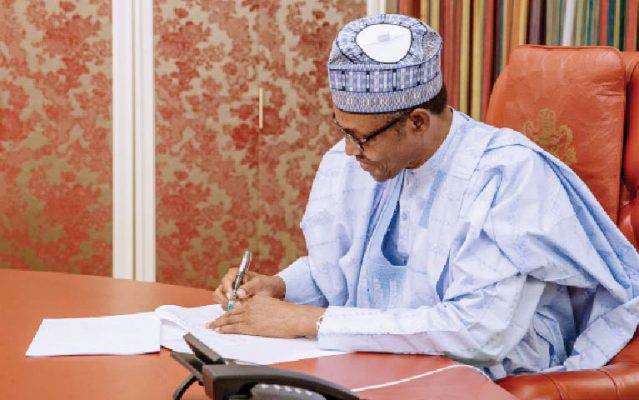
President Muhammadu Buhari has approved replacements for heads of Federal Government agencies that were recently appointed as ministers.
A statement by the president’s spokesman, Malam Garba Shehu, in Abuja on Tuesday, said Sen.
Basheer Garba Mohammed was appointed Federal Commissioner, National Commission for Refugees, Migrants and Internally Displaced Persons.Mohammed replaces Sadiya Umar Farouk, a minister-designate from Zamfara.
According to the statement, Dr Chioma Ejikeme has been appointed Executive Secretary, Pension Transitional Arrangement Directorate, replacing Sharon O. Ikeazor, while Kashifu Inuwa Abdullahi is now Director General/CEO, National Information Technology Development Agency.
“For Executive Commissioner (Stakeholder Management), Nigerian Communications Commission (NCC), President Buhari has forwarded Adeleke Moronfolu Adewolu’s name to the Senate for confirmation as replacement for Sunday Akin Dare.
“The appointments take immediate effect,’’ the statement added.(NAN)





By Tony Obiechina, Abuja
Latest reports from the National Bureau of Statistics(NBS) indicates that Nigeria’s inflation rate for April 2026 reached 15.69% year-on-year, confirming a continued upward pressure from the 15.38% recorded in March.
Prince Adeyemi Adeniran, statistician General of the Federation in a statement said the report showed that the slight increase follows a rise in food and energy costs in March marking a halt to earlier disinflationary trends.
The NBS said following the completion of the recent rebasing exercise, the current report is centred on a new CPI base year of 2024 and a weight reference period of 2023, adding that the Consumer Price Index (CPI) increased to 138.
3 in April 2026, and reflects a 2.9-point increase from the preceding month.According to the report, the month-on-month headline inflation rate in April 2026 was 2.13%, which was 2.05% lower than the rate recorded in March 2026 (4.18%).
‘At the divisional level, the three major contributors to the headline inflation were Food and non-alcoholic Beverages: 6.40%, Restaurants & Accommodation Services: 3.56%, andstatement Transport: 1.70%; while the least contributors a were Recreation, Sport, and Culture: 0.01%, Alcoholic Beverages, Tobacco, and Narcotics: 0.01%, and Insurance and Financial Services: 0.03%’.
The Food inflation rate in April 2026 was 16.06% on a year-on-year basis, lower than 24.68% recorded in April 2025.
Also, on a month-on-month basis, the Food Inflation rate in April 2026 was 3.63%, down by 0.54% points from March 2026 (4.17%). This can be attributed to the rate of change in the average prices of Millet Whole grain, Yam Flour, Ginger (Fresh), Beef, Garri, Yam Tuber, Pepper (Fresh), Cray Fish, Cassava Tuber, Beans, Irish Potatoes, Tomatoes (Fresh), Wheat Grain (Sold loose), Soy Beans, Guinea Corn, Plantain, Carrots (Fresh), among others.
Core Inflation, which excludes the prices of volatile agricultural produce and energy, stood at 15.86% in April 2026 on a year-on-year basis. On a month-on-month basis, the core inflation rate was 1.03% in April 2026, down by 3.0% compared to March 2026 (4.03%).
The inflation rate of the sub-indices for April 2026 shows that the monthly change recorded were Farm Produce (6.0%), Energy (8.0%), Services (2.1%), Goods (3.2%) and Imported Food (4.4%).
Meanwhile, the inflation rate on a year-on-year basis recorded were as follows; Farm Produce (19.8%), Energy (4.6%), Services (16.7%), Goods (15.7%) and Imported Food (10.5%).
On a year-on-year basis, the urban inflation rate in April 2026 was 15.40%. On a month-on-month basis, the urban inflation rate was 1.86% in April 2026, down by 1.3% compared to March 2026 (3.16%).
The rural inflation rate in April 2026 was 16.36% on a year-on-year basis. On a month-on-month basis, the rural inflation rate in April 2026 was 2.80%, down by 3.93% compared to March 2026 (6.73%).
In analysing price movements under this section, it should be noted that CPI is weighted by consumption expenditure patterns that differ across States and locations.
Accordingly, the weight assigned to a particular Food or Non-Food item may differ from State to State making interstate comparisons of consumption basket inadvisable and potentially misleading

By David Torough, Abuja
ARKAN BUILDERS LIMITED has joined dignitaries, stakeholders, and well-wishers across Nigeria in celebrating the Governor of Benue State, Rev. Fr. Dr. Hyacinth Iormem Alia, on the occasion of his 60th birthday, describing him as a courageous leader whose vision continues to inspire hope and transformation.
In a goodwill message signed by the company’s Managing Director, Engr.
Mazen Kalassina, the construction firm praised Governor Alia for his dedication to purposeful leadership, integrity, and service to humanity.According to the statement, Governor Alia’s leadership style reflects resilience, compassion, and a strong commitment to rebuilding confidence in governance and restoring dignity to the people of Benue State.
“Your remarkable journey demonstrates the strength of faith-led leadership rooted in integrity, compassion, and an unshakable resolve to build where others hesitated,” the statement read.
The company further noted that the governor’s achievements have inspired renewed optimism and laid a strong foundation for sustainable development in the state.
ARKAN BUILDERS LIMITED stated that, as an organization committed to creating lasting legacies and empowering communities, it deeply appreciates leaders who understand that true development goes beyond infrastructure to transforming lives and strengthening institutions.
The firm prayed for renewed strength, divine wisdom, good health, and greater accomplishments for the governor as he continues to lead the state with courage and purpose.
Governor Hyacinth Alia clocks 60 with widespread commendations from supporters and admirers who describe his administration as one driven by reform, hope, and visionary service.
By Bridget Tikyaa
Just last week, Accolades Dynamics Limited bestowed an award of excellence for Governor Hyacinth Alia on his infrastructure revolution and impactful economic development of Benue State. To discerning minds, this is a recognition well deserved.
A recognition of impact and commitment to turning the sordid history of Benue State, which was run aground by the immediate past administration of the state. In fact, the governor, on assumption of duty in 2023, described the situation in the state as very dire, but was quick to make a commitment: “My administration will not fail the Benue people. A lot of things went wrong in the State, but my government is here to rebuild and make it better for all.”This he has been doing boldly, without doubt. So, when the Governor won the Accolade Yellow Ball award as the best Governor in Infrastructure and Economic Development, it was an apt recognition of a leader who has vowed to raise Benue from the doldrums, a leader whose commitment to greater Benue is etched on solid infrastructure, human capital development, entrepreneurship, industrial revival, agricultural and educational transformation,a vibrant healthcare system, among others.
Those who issued the award said, under the leadership of Hyacinth Alia, Benue State has witnessed a remarkable wave of infrastructural renewal aimed at reconnecting communities and stimulating economic growth.
The recognised has massive road construction and urban renewal projects across the state, the completion and ongoing construction of dozens of intra city roads in Makurdi and other major towns, as well as hundreds of kilometers of rural road networks, bridges, and drainage systems designed to mitigate flooding, improve transportation, trade, and access to essential services.
Justifying the award further, they stated that the Governor’s infrastructure drive has transformed public facilities and government institutions through the renovation of schools, public offices, and key state structures, pointing out projects such as the Makurdi and Gboko underpasses, modernization of the State Secretariat, and rehabilitation of critical public infrastructure that reflect his vision of giving Benue a modern and functional outlook.
In all these, they were right because Governor Alia’s administration has been quite busy with several major infrastructure projects in Benue State. Some notable ones include over 390km of roads under construction across the 23 Local Government Areas, with 16 township roads completed and 25 more underway in Makurdi. There is also the multi-billion Naira Cancer Centre being built at the Benue State University Teaching Hospital, and the Otobi Water works in Benue South Senatorial District, which has been completed.
In the education sector, the government is undertaking the renovation and construction of schools, including a new university at Ihugh in Vandeikya LGA, as well as the massive recruitment and training of teachers.
In the area of industrialisation, the governor has revitalised the Benue Brewery Limited, producers of Zeva Premier Beer, the Benue Fruit Company, and the Taraku oil mill.
In digital transformation, three key digital platforms have been introduced: Benue State Geographic Information System (BENGIS) Portal, Electronic Document Management System (EDMS), and Benue Youth Startup and Innovation Support Portal.
These projects and more aim to improve access to healthcare, education, and public utilities while boosting economic growth and mobility in the state.
Governor Alia’s administration has also been working on several other initiatives to boost Benue State’s economic development. In agriculture, the government has subsidized fertilizers, provided tractors at affordable rates, and launched initiatives to boost agricultural productivity, aiming to restore Benue’s national lead as an agro-industrial hub.
Security and job creation are at the heart of any development. These are being pursued relentlessly. The dire security situation in the state when the administration came in 2023 has now been confined to three out of seventeen local government areas facing existential threats from armed groups and terrorists. The government not only set up a 5,000-strong Benue Civil Protection Guards but also created jobs through youth empowerment programs.
No doubt, these projects have improved the quality of life for Benue citizens, drive economic growth, and positioned the state as a hub for innovation and investment.
Governor Alia’s infrastructure projects are transforming Benue State, bringing numerous benefits to local communities, enhancing mobility and access to markets, schools, and healthcare facilities, providing clean water to residents, enhancing access to education, and ensuring overall economic growth.
Indeed, these projects have not only improved infrastructure but also restored confidence among the grassroots, with local people praising the governor’s inclusive governance and visible development. Benue is indeed in a safe hand, marching to unprecedented greatness under the able leadership of Rev. Fr. Hyacinth Iormem Alia.
Bridget Tikyaa Is the Principal Special Assistant to the Governor on Media, Publicity and Communications Strategy



Nigeria’s Inflation Rate Jumps to 15.69 Per Cent in April – NBS
ShareBy Tony Obiechina, Abuja Latest reports from the National Bureau of Statistics(NBS) indicates that Nigeria’s inflation rate for April 2026...


Troops Neutralise Terrorists, Rescue Dozens of Kidnap Victims in Nationwide
ShareBy David Torough, Abuja OperationsThe Armed Forces of Nigeria (AFN) has recorded major operational successes across the country between 8...


Security Expert, Jackson Ojo Lauds Tinubu Over Appointment of Homeland Security Adviser
ShareBy Mike Odiakose, AbujaA security expert and executive protection specialist, Dr Jackson Lekan Ojo, has applauded President Bola Tinubu over...


ARKAN Builders Celebrates Gov. Hyacinth Alia at 60, Hails Visionary Leadership in Benue
ShareBy David Torough, Abuja ARKAN BUILDERS LIMITED has joined dignitaries, stakeholders, and well-wishers across Nigeria in celebrating the Governor of...


Letting Di’ja Go Was Most Difficult Decision of My Career – Don Jazzy
ShareRecord producer and music executive, Michael Collins Ajereh, popularly known as Don Jazzy, has revealed that letting former Mavin artist,...
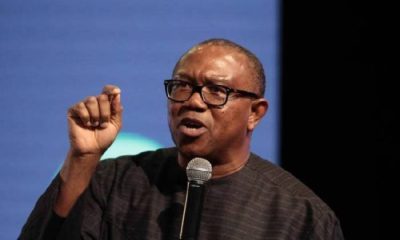

Can Obi Break Tinubu’s Incumbency, and Can Northern Alliances Unseat Jagaban?
ShareBy Daniel Nduka Okonkwo As Nigeria gradually moves toward the 2027 presidential election, political conversations across the country are increasingly...


Excellence Award and Alia’s Transformational Impact for Greater Benue
ShareBy Bridget Tikyaa Just last week, Accolades Dynamics Limited bestowed an award of excellence for Governor Hyacinth Alia on his...


Alia: 60 Years of Purposeful Life, Leadership
ShareRev. Fr Hyacinth Iormem Alia is marking his 60 years today in this wonderful world. It has been 60 years...

Happy Birthday to a Visionary Leader
ShareYour Excellency, Rev. Fr. Dr. Hyacinth Iormem Alia (Asortar ù Tiv) Today, history pauses; not merely to count years, but...
Gov Alia Believes in High Standards and Capability in Leadership of Benue State – Iorpev
ShareThe Technical Adviser to Benue State Governor on Media, Publicity and Strategic Communication, Chief Solomon Terver Iorpev, spoke with our...