
Health
Girl-child Education Instrumental to Reducing Gender-based Violence — Malala Fund

The Malala Fund says educating the girl-child is instrumental in reducing Gender-Based Violence in Nigeria
Ms Pearl Uzokwe, U.
S. Board Member, Malala Fund, stated this in an interview on Friday in Lagos.Uzokwe spoke against the background of the 16 Days of Activism against Gender-Based Violence, an annual international campaign that runs from Nov.
25 to Dec. 10, Human Rights Day.The week focuses on “raising awareness to the devastating impact that gender-based violence and femicide (GBVF) has on women and children, and the social fabric of our society”.
The theme of the week for 2023 is “Unite by 2030 to End Violence against Women and Girls (VAWG)”
Uzokwe said that the civil society remained power advocates and this is where the Malala Fund ‘where I sit on the board comes in.’
“Our mission remains `12 years of good quality education for the girl child’.
“We advocate for policy changes, invest in local education initiatives, and amplify the voices of girls around the world who are fighting for their right to education,” Uzokwe said.
She said that it was important to realise the intersectionality between gender -based violence against the girl-child and girl-child education.
According to her, it is a complex and critical one that involves the overlapping impact of various forms of discrimination and oppression.
“Gender-based violence without a doubt is a barrier to education. Coupled with that is the often cyclical relationship between GBV and lack of education.
“Girls who are denied education may face increased vulnerability to sexual violence due to limited opportunities, economic dependence etc.
“It is for reasons such as this, that Malala Fund which began its work in Nigeria in 2014, is committed to playing its part in reducing the seven million out-of-school girls in the country.
“To do that, hurdles including sexual violence, are part of the consideration,” Uzokwe said.
She noted that Malala Fund had invested more than $6.1 million in education work in Nigeria and in total awarded 52 grants.
She explained that the investment of the fund in Nigeria has impacted 14,000 children with direct services (such as school enrollment initiatives, advocacy trainings, and life skills trainings) and nearly six million children indirectly (through teacher trainings, policy change, and digital technology access).
“In Nigeria we currently fund 15 Education Champion organisations working directly at the grassroots.
“Helping to break barriers to education, including gender-based violence and two Girl Fellows, with a further three Fellows being brought on shortly,” Uzokwe said.
According to her, she is strong advocate for justice and the need for punitive measures in tackling the issues of GBV.
She said that legislations against GBV should be backed with enforcement to serve as a major deterrent.
“Our legal systems must become beacons of hope, not sources of further distress,” Uzokwe said.
She appealed to the private sector and corporate organisations to put in measures that would forestall the incidences of GBV whether at home or in public offices and spaces.
“The beauty of the work in this area is that each and everyone one of us can contribute to eliminating this. Our homes lay the foundation and the tone for what is acceptable in larger society.
“Let us train both boys and girls to truly respect and uphold the girl child and women.
“Fathers, I am specifically pleading and calling on you today as your urgent voices matter more than ever.
“A girl’s self-esteem is often times made or marred in equal proportion to the validation they get from their fathers.
“Don’t just think it, or spend your way to it…, actively speak it over those girl-children and build them up.
“For your sons, don’t just tell them how to treat women, but actively model it. Your example will outlive any words you use,” Uzokwe said.(NAN)
The Niger State Private Health Facilities Agency (NiSPHFA) has sealed 12 unregistered Islamic medicine stores in Minna and a health facility in Katcha Local Government Area (LGA).
The Executive Chairman of NiSPHFA, Dr.
Abdullahi Suleiman, disclosed this while receiving members of the Islamic and Prophetic Medicine Practitioners’ Association of Nigeria (IPMPAN) in Minna.The enforcement is part of the agency’s renewed efforts to protect residents from unsafe healthcare practices and ensure compliance with minimum standards.
Suleiman said the facilities were sealed over alleged non-compliance with regulatory standards.
According to him, the enforcement is not aimed at persecuting healthcare providers but at ensuring residents have access to safe, quality, and standard-compliant healthcare services.
“Our responsibility is to protect the people by ensuring that anyone providing healthcare services operates within the required standards,” he said.
He urged genuine alternative medicine practitioners to register with NiSPHFA, saying registration would enable the agency to identify operators, monitor their activities, and protect residents from unsafe products and practices.
Suleiman also announced plans to organise a trade fair for verified alternative medicine practitioners to promote legitimate practices and improve public confidence in alternative healthcare.
He emphasised the need for practitioners to maintain minimum standards of hygiene, sanitation, safe preparation and storage of medicines, proper packaging, and infection prevention.
“Practitioners should refer patients whose conditions are beyond their capacity to appropriate health facilities. Such referrals will help reduce avoidable health risks,” he said.
The chairman said sustained enforcement, stakeholder collaboration, and improved compliance would enable NiSPHFA to safeguard residents and promote a safer, more accountable, and quality-driven healthcare system across the state.
He said the NiSPHFA enforcement team inspected 10 health facilities in Katcha local government and identified various irregularities requiring improvement.
Suleiman said the affected facilities were issued 21-day notices to correct the identified deficiencies.
“One of the facilities inspected was sealed for non-compliance with established standards,” he said.
He added that the agency also secured the support of the local government area in identifying and addressing facilities operating with irregularities.
IPMPAN Chairman, Abdullahi Haske, commended the state government for establishing NiSPHFA.
He pledged the association’s cooperation in ensuring that its members complied with regulatory requirements.
Stakeholders have called for improved implementation, tracking and accountability of health sector budgets to strengthen healthcare delivery and advance Universal Health Coverage (UHC) in Kaduna State.
They made the call during an engagement on strengthening participatory budget processes, health budget tracking and advocacy on Saturday in Kaduna, with emphasis on the 2027 budget process and implementation of the Annual Operational Plan (AOP) for the health sector.
Seth Luke, a Civil Society Coach on strengthening participatory budget processes under the Open Government Partnership (OGP) Kaduna, said the engagement was aimed at strengthening the capacity of OGP Technical Working Groups and state and local government accountability mechanisms to effectively participate in budget processes and advocacy.
Seth said the engagement was particularly focused on the health sector, including tracking the implementation of the Annual Operational Plan as the state commenced preparations for the 2027 budget.
“We want to see how we can track the implementation of the Annual Operational Plan for the health sector and, from our findings, bring out recommendations around improving funding and other areas that require attention,” he said.
He said the government needed to prioritise health financing beyond budgetary allocation by ensuring effective implementation of approved programmes and projects.
According to him, budget allocation represents government plans based on expected revenue, but available resources should be prioritised toward activities capable of improving healthcare and service delivery at the grassroots.
Seth urged participants to use the knowledge and findings from the engagement to engage relevant government stakeholders on improving health financing and budget implementation.
He also encouraged them to extend the knowledge gained to other sectors and continuously engage government on budgeting, accountability and service delivery.
Similarly, Garba Mohammed, Co-Chair of the Kaduna Maternal Accountability Mechanism (KADMAM), said the engagement was aimed at reviewing health budget performance against key indicators linked to maternal mortality reduction and child survival.
Mohammed said participants examined first and second quarter performance, particularly in areas such as family planning, Maternal, Newborn and Child Health (MNCAH), nutrition, malaria, immunisation and essential medicines.
He said family planning interventions largely involved commodities at the primary healthcare level, while MNCAH activities remained largely donor-dependent.
Mohammed commended the Kaduna State Government for meeting the Abuja Declaration benchmark of allocating at least 15 per cent of its annual budget to health.
He, however, expressed concern over gaps in the implementation of some critical health budget lines, stressing that allocation alone was not enough to improve health outcomes.
“We have looked at the budget allocation, and Kaduna State has met the 15 per cent Abuja Declaration benchmark. We commend the state for that. However, there are still issues around budget performance in critical health indicators,” he said.
He said the findings would be used to identify advocacy priorities and engage key government decision-makers, including the Ministry of Health, Planning and Budget Commission, Ministry of Finance and other relevant authorities.
Mohammed said participants were expected to understand the relevant health budget lines and their implementation status and use the knowledge to undertake evidence-based advocacy in their respective organisations.
Meanwhile, Yusuf Guje, Executive Director, Civic Impact for Sustainable Development Foundation (CISDF), and a participant at the programme, told the News Agency of Nigeria (NAN) that the engagement was timely in strengthening the capacity of civil society and accountability mechanisms.
Guje said the programme would deepen participants’ capacity in budget tracking, project monitoring and social auditing, particularly within the health sector.
He described the health sector as a critical pillar of development, saying civil society organisations had an important role to play in complementing government efforts through effective monitoring and accountability.
He said CSOs needed to strengthen their ability to analyse budgets, track expenditure and visit healthcare facilities to determine whether appropriated and released funds were being properly utilised.
“Civil society needs to really improve on how effectively we analyse the budget, how we track the spending, and go down to the various facilities to see how well the money appropriated and released is being utilised,” Guje said.
He said effective monitoring would help determine the extent to which communities benefited from government investments in healthcare.
According to him, Kaduna State’s commitment to Universal Health Coverage could only be strengthened through sustainable health financing and effective accountability mechanisms.
Guje described CSOs as representatives of communities that often lacked the knowledge, skills and platforms required to engage government on public policies and resource allocation.
He therefore urged civil society actors to continuously strengthen their capacity to represent citizens effectively, particularly in health financing advocacy and accountability.
“As civil society, we need to remain committed to holding the government accountable where necessary and tracking the entire health financing process,” he said.
Guje said the ultimate objective of budget tracking and social accountability was to ensure value for money in public expenditure on health.
He added that effective monitoring of public finances would contribute to improved healthcare delivery and better health outcomes at the grassroots. (NAN)
Cross River Government has made enrolment in the state Health Insurance Scheme compulsory for all civil and public servants in the state.
The Head of Service, Bassey Okon, announced this in a circular dated Sept.
3, following the official relaunch of the Formal Sector Enrolment Programme of the Cross River State Health Insurance Agency.According to the circular in Calabar, at the weekend, the directive takes immediate effect.
Okon stated that the policy was meant to ensure that all the civil and public servants had access to affordable, quality, and timely healthcare services, while strengthening the welfare and productivity of the state workforce.
He directed all the civil and public servants to enroll in the scheme and comply with the registration and documentation requirements of the agency.
The circular also introduced a mandatory requirement for officers to attach valid health insurance enrolment cards to official correspondences relating to personnel matters.
“Correspondences concerning promotion, confirmation of appointment, loan applications, study leave, training or sponsorship, transfer or secondment, as well as other personnel-related requests or benefits, would not be processed without the attachment of a valid health insurance enrolment card,” it stated.
To facilitate the enrolment process, the government established enrolment points at the Office of the Head of Service, New Secretariat, Calabar, and the Ministry of Health, Old Secretariat, Calabar.
Okon directed all Heads of Ministries, Departments, and Agencies (MDAs) to ensure that officers under their supervision were duly informed about the circular and made to comply with the enrolment requirement without delay.
He also urged concerned officers to take advantage of the designated enrolment points for guidance and assistance and to complete their enrolment as required.
He further directed all the heads of the MDAs to bring the contents of the circular to the attention of all civil and public servants under their supervision. (NAN)




Beyond Peter Obi’s Benue Woes: Why Nigeria Must Defend Everyone’s Rights
ShareBy Ebuka Ukoh There are moments when a country must speak with one voice… not because its citizens agree on...

When Managers of Social Clubs Continue to Run Our Economy
ShareBy Uddin Ifeanyi The spectacle of a senior adviser on economics to the Tinubu government dissing the numbers on the...


LASCOPA Warns against Rusty Grinding Machines over Contamination Risks
ShareThe Lagos State Consumer Protection Agency (LASCOPA) has warned operators of pepper and grinding machines against using rusty or poorly...

ICPC, NFIU Open Stocktake on Financial Intelligence, Asset Recovery
ShareThe Independent Corrupt Practices Commission (ICPC) and Nigerian Financial Intelligence Unit (NFIU) on Monday in Abuja commenced a three-day stocktake...


Dangote Refinery IPO Frenzy Overloads Two Investment Sites
ShareBy Tony Obiechina, Abuja The much-anticipated public offering of Dangote Petroleum Refinery and Petrochemicals FZE sparked a rush among retail...


2027 Polls: Parties Demand Credible Vote, Vow to Protect Mandates
ShareBy David Torough, Abuja As preparations intensify for the 2027 general elections, political parties are stepping up demands for greater...


Tinubu Unveils 20-Year North Central Economic, Infrastructural Growth Plan
ShareBy David Torough, Abuja President Bola Tinubu has directed the timely release of funds due to Regional Development Commissions across...
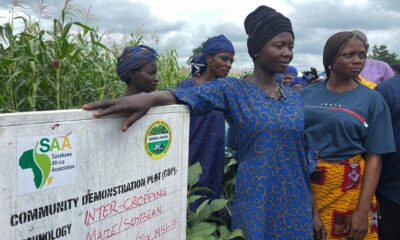

Sasakawa Africa Establishes Agro-Enterprise Centre, Empowers Over 8900 Smallholder Farmers In Benue
ShareFrom Attah Ede Makurdi The Sasakawa Africa Association Nigeria (SAA Nigeria), with funding support from The Nippon Foundation (TNF), has...


Hope Rekindled as Ankwa Amo Inspects Modern Market, Promises Govt Attention
ShareBy Julius Tambaya, Abuja Hope of renewed government intervention has risen among traders at Modern Market, Makurdi, following an inspection...


North Central Devt Commission ‘ll Drive Regional Transformation, Restructuring – Golu
ShareBy David Torough, Abuja Former member of the House of Representatives from Plateau State, Hon. Timothy Golu, has described the...