
OPINION
Igboho’s Cats, Kanu’s Interception and Buhari’s “Language”

By Reuben Abati
When a few weeks ago, President Muhammadu Buhari declared that those who seek to overwhelm and undermine the Nigerian state would soon be spoken to in the language that they will understand, this was immediately interpreted to serve as a signal of a declaration of war against the people of the South-East, because the President spoke in the context of war, as he referred to the civil war of 1967-70.
Subsequently, the President made it clear that the language of engagement would be communicated, not just in the South-East, but in every part of the country, including the North-West and North-East and elsewhere in the country where attempts are being made to sabotage the sovereignty of Nigeria, and the government’s responsibility to ensure the security and welfare of the people.Last week, Nigeria found itself in the grip of a security turmoil, and that promised confrontation with “language.” Nnamdi Kanu, leader of the Indigenous People of Biafra (IPOB), and founder of the Eastern Security Network (ESN), two organisations promoting separatism or secession, and committed to the actualisation of a Republic of Biafra to be carved out of Nigeria, was intercepted, re-arrested/extradited, and rendered Nicodemously, back to Nigerian soil. Nigerians got to know about the operation through a press conference by the Attorney General of the Federation/Minister of Justice, Abubakar Malami (SAN), who disclosed that Kanu was intercepted with the help of intelligence and security services. Kanu was re-arraigned in court on Tuesday, June 29.
The presiding Justice ordered that he should be remanded in the custody of the Department of State Services until July 26. Second incident: In Soka, Ibadan, Department of State Services (DSS) officials stormed the home of Chief Sunday Adeyemo, a.k.a, Sunday Igboho, the Yoruba co-promoter of the idea of an Oduduwa Nation, a modern-day defender of the Yoruba territory against the incursion of criminally-minded Fulani herdsmen into the South-West. The DSS has since declared Igboho a wanted man. He has reportedly said that nobody can intimidate him, because he has not committed any crime and that he is in his house despite the attack on him, his aides and his properties by State Security. Third incident: The brusque manner in which the Nigeria Police put an end to the Yoruba Nation rally at the Freedom Square, Ojota, Lagos, on Saturday, July 3. Not only did the Police block the people’s right to protest (which is condemnable), the life of a young lady was snuffed out, according to one account, by a stray bullet, but the police insist that she died from a knife-stab. She did not deserve to die.
These three incidents can be taken as an indication of “the language” that the President recently spoke about. It is the language of power, in form of an affirmation of the supremacy of the state. The only problem is the politics of it, the tone, nature and fall-outs and how the Nigerian government is doing the right thing in a wrong, untidy and controversial manner. What is right? And what is wrong? The Buhari administration has consistently insisted on the sovereignty of Nigeria, its indivisibility and indissolubility, in line with the Preamble of the 1999 Constitution and Section 2(1) thereof, in addition to its resolve to uphold the same principles and provisions. In the face of calls for secession, restructuring, and a referendum on the future of Nigeria and the state of the Union, government spokespersons have argued that whereas the Constitution can be amended, and the country can be restructured, as the people wish, this has to be done through the legislature, and not outside the extant constitutional framework. Those who insist that the 1999 Constitution is a “military invention” and not a “Peoples Constitution” have also been told that the latter, which they seek through a referendum, without the National Assembly, would amount to an unconstitutional proposition. There is no provision for a people’s referendum, or any contemplation of secession or separation by any part of the Federation known as Nigeria, in the 1999 Constitution.
This is the source of the difference between the separatist groups led by the likes of Chief Sunday Adeyemo and Nnamdi Kanu and other ethnic nationalists. The latter argue that Nigeria’s 1914 amalgamation has since expired and given that government is not prepared to re-negotiate the terms of the union, in the face of so much injustice, mis-governance and inequity in the land, it is better for those aggrieved groups within the federation to re-define their own destiny. Self-determination is a universally recognised right under Articles 1(2) and 55 of the United Nations Charter. The Nigerian government has been careful not to openly use that phrase, self-determination, but it rails against any effort to achieve that objective through the means of violence, or deliberate mobilisation to undermine Nigeria. “No responsible government will fold its arms” and allow non-state actors to overwhelm it is the common phrase we hear. Or something like the government’s responsibility to defend the rule of law or that the unity of Nigeria is non-negotiable. This is, of course, readily dismissed as hypocritical by those who accuse the Nigerian government of having no regard whatsoever for the rule of law, and hence no moral high ground to stand upon.
Sunday Igboho is committed to the actualisation of an Oduduwa Nation, which means the South-West of Nigeria pulling out of the Nigerian federation. He also defends the Yoruba territory. He has led rallies across the South-West, in Ibadan, Osogbo, Akure, Abeokuta, Ado-Ekiti, to sensitise and mobilise the people. The proposed Oduduwa Nation has its own anthem and a national flag. The latest rally was scheduled for Lagos, July 3. Two days earlier, the DSS attacked Igboho’s residence in Ibadan in the middle of the night. In the case of Nnamdi Kanu, he had been arrested by the Nigerian government in 2015, and taken to court on a nine-count charge of treasonable felony and other offences. IPOB, which he leads, was later proscribed and declared a terrorist group. In April 2017, Kanu was granted bail, under strict conditions. In September 2017, he jumped bail and became a fugitive from the law. He was declared wanted.
While on the run, Nnamdi Kanu and his associates sustained an attack on Nigeria through propaganda and other organised activities in the South-East. Without doubt, both Igboho and Kanu had become persons of interest to the Nigerian state. Igboho had been invited in the past by the police. There was also an unsuccessful attempt by state agents to kidnap him on the Lagos-Ibadan Expressway on one occasion. Igboho has remained undeterred. He has pursued his Yoruba Nationalism with gusto. It is not beyond the state to take an interest in him. As for Kanu, what the state has proven in his case is that whereas the will of the state may be slow, it will eventually prevail, and that nobody is above the laws of the land. The argument that Kanu is a British citizen offers neither a defence or immunity under the law. Dual nationality, which Nigerian laws recognise, does not grant anyone the right to or seek to overwhelm the Nigerian state and expect the affected state to look the other way.
What is wrong is how Nigeria has handled the two cases in question. Igboho’s house was attacked in the dead of the night, ostensibly without prior notice, in a Gestapo style reminiscent of those locust years of military dictatorship. The DSS claims that its team was attacked as it approached Igboho’s residence. So? In the absence of any prior notice, the DSS team could well have been regarded as intruders coming to do harm. Given his circumstances, any reasonable person would expect Igboho to have security arrangements at his home to keep intruders out. Did the DSS officials identify themselves before approaching the house, like the use of a public address system, asking Igboho to surrender himself? In trying to assert the might of the state, the DSS adopted extra-legal tactics. Two persons were killed, including an aide who was reportedly on a praying mat. Wives, including Igboho’s wife, were carted away, but released later. 13 persons ended up in custody. The vehicles in the compound were sprayed with bullets and damaged. This certainly cannot be a standard security agency operating procedure. DSS said it was acting on a tip off that Igboho was stockpiling arms in his home. The man says the few arms and ammunition that have been paraded do not belong to him. He is a traditionalist he insists, who deploys metaphysical powers. The DSS team was looking for arms, but they also ended up killing and arresting Igboho’s cats. Cats! Ologbo Iya agba. Ologbo Ijeun. Meow, Meow. Pussy Cat. How ridiculous. Did the cats also resist the invasion of Igboho’s residence?
The international community must be having a good laugh at Nigeria’s expense about this cruelty to animals and the ethno-theological assumption that it is possible for Sunday Igboho, a human being, to turn into a cat to escape arrest. The US SEAL team came all the way to Nigeria in October 2020, on a special security operation to rescue a 27-year-old Philip Walton, who had been kidnapped in Niger and brought to Nigeria. It was a precision operation, driven by science and professionalism. Nigerian security agents are always busy looking for fetish objects. Many of our own security agents will be better off joining the Vigilante, the Amotekun, the hunters’ guild or Ebube Agu. Igboho’s cats have not yet been paraded by the DSS. Those cats should also be allowed to have their day in court and their charges properly read out to them. I have no doubts that there will be more than enough lawyers who will take up their matter, pro bono, to make the simple argument that under Nigerian laws, an animal is not a juristic entity. Until that matter is determined, nothing must happen to those cats. Everything must be done to ensure that they do not end up in anybody’s pot of soup as a captured delicacy and spoil of war!
It is this same sloppiness that we have seen in the Kanu case. Ordinarily the matter should not have generated any controversy at all. A man runs away from the law. The law catches up with him. Simple. He should have his day in court. But the whole thing has been turned into something else because of the lack of clarity about the circumstances of his arrest. The Nigerian government has not even disclosed how and where he was arrested, the international agencies or governments that provided support, and how he was brought back into the country. The secrecy has now given room to needless speculation, confusion, and conspiracy theories. The Kenyan authorities have said, for example, that he was not arrested in Kenya. Persons close to him insist that not only was he arrested in Kenya, he was also tortured by Kenyan officials before he was handed over to the Nigerian authorities. By doing the right thing wrongly, the Nigerian government is gradually turning the narrative against itself, and turning both Igboho and Kanu into heroes among their supporters, and across ethnic constituencies in the South and the Middle Belt. We have now reached a point whereby Nnamdi Kanu’s supporters in the South-East are supporting and defending Sunday Igboho of the South-West and vice versa.
The emerging conversation is gradually focussing on due process, the right to self-determination and why in speaking language to power, the Nigerian state has not deemed it necessary to arrest anyone involved in attacks on the sovereignty of Nigeria in the Northern parts of the country. Questions: Can the point be confidently made that it is only in the South that non-state actors challenging the integrity of the state can be found? How about the Boko Haram and ISWAP in the North-East and the bandits in the North-West? Only yesterday, Boko Haram reportedly appointed a governor of its own to oversee parts of Borno State. Why is the government not going after whoever is the so-called Boko Haram governor? Will he appoint commissioners too and collect tax? Why are Boko Haram terrorists being approached for negotiation and offered chances of rehabilitation, unlike agitators in the South? These are the kind of questions being raised. No government that expects to be taken seriously can afford to lay itself open to such charges of double standards. Other commentators have gone further to insist that what needs to be addressed are the specific issues that continue to throw up non-state actors who question the value of the Nigerian state: these are issues of equity, fairness, justice, good governance and ensuring a collective sense of ownership and belongingness among Nigerians, not through vapid rhetoric but concrete actions. It is not an accident that these latter points are captured in spirit, in the communique issued at the conclusion of the meeting of the 17 Governors of Southern Nigeria held in Lagos on Monday, July 5.
The Federal Government of Nigeria needs to manage the crisis of confidence it faces. It needs to rebuild trust. It can start by ensuring that the right things are done in an open and just manner, that is fair to all parties concerned. And the security agencies must play their own part by always acting professionally. On Saturday in Lagos, a young lady who was not even part of the Yoruba Nation rally lost her life. In less than 24 hours, the Lagos Police Command told the public that no policeman fired any shot at all (something that was seen on television!), and that the victim did not die as a result of gunshot wound (did the police carry out an autopsy to determine the cause of death so fast?). State officials must learn to be truthful, otherwise whatever they do or say will be politicised and treated with doubt and suspicion.
Reuben Abati, a former presidential spokesperson, writes from Lagos.





By Isaac Asabor
The recent incident involving a media professional and a representative of the Federal Capital Territory administration has raised important questions about the safety, dignity and independence of broadcasters in Nigeria.
At the heart of the matter is not simply an exchange between an individual broadcaster and a public official.
It is a broader question of how the media should respond when attempts are made to dictate the circumstances under which broadcasters perform their professional duties.Broadcasters have a responsibility to stand in solidarity with one another when the independence of the press comes under pressure, particularly when attempts to dictate who can question public officials threaten to become accepted practice.
The Independent Broadcasting Association of Nigeria (IBAN), a national body representing private television and radio broadcasters across Nigeria, exists to advance excellence, fairness and innovation in the media industry. Its role underscores the importance of protecting an independent broadcasting sector capable of serving the public without undue interference.
Independent broadcasters are central to Nigeria’s media pluralism. They provide diverse perspectives that reflect the country’s rich mix of cultures, languages and communities. They also create platforms through which grassroots voices can be heard and communities can engage with issues that directly affect their lives. That role makes editorial independence particularly important.
Unlike state-controlled media, independent broadcasters have a responsibility to maintain editorial freedom and local relevance. Their strength lies in their ability to provide space for different perspectives, including views that may sometimes challenge those in positions of authority.
It is against the foregoing background that the incident deserves broader consideration. One of the most troubling aspects of the matter is the apparent attempt to determine which journalist should be allowed to ask questions while an official was being represented. Public officials are accountable to the public, and journalists serve as one of the channels through which citizens demand that accountability.
A public official cannot reasonably expect to determine which journalist or broadcaster rather is qualified to ask questions simply because the questions may be uncomfortable.
Broadcasters may differ in style, experience and approach, but the right to ask legitimate questions should not depend on whether those questions are convenient to the person being interviewed.
Allowing public officials to select only journalists they consider friendly or acceptable would create a dangerous precedent. It could gradually turn press engagements into controlled public-relations exercises rather than opportunities for scrutiny.
That is why broadcasters should regard any attempt to undermine the independence of a colleague as a matter that concerns the wider profession.
Another concern arising from the incident is the apparent shift from addressing substantive questions to criticizing the journalist asking them.
Questions surrounding public land, government resources or the conduct of public officials are matters of legitimate public interest. They deserve clear answers, not personal attacks against the journalist who raises them.
A journalist’s personality, background or perceived disposition should not become a convenient distraction from the issue being investigated.
This does not mean journalists should be immune from criticism. They can, and should, be held accountable where they breach professional standards. But criticism should be based on facts and established journalistic principles, rather than being used as a weapon to intimidate journalists into silence.
When personal attacks become the preferred response to legitimate scrutiny, the larger casualty is public accountability.
Broadcasting is a profession that must defend its boundaries. This is particularly important because the incident comes against a background of recurring friction between government authorities and sections of the broadcast media.
Such disagreements are not unusual. Journalists and public officials will inevitably clash from time to time, particularly when reporters pursue difficult questions. What matters is how both sides respond to those disagreements.
For broadcasters, professionalism must remain paramount. Questions should be fair, relevant and supported by facts. But professionalism should not be confused with submission.
A journalist can be respectful without surrendering independence. A broadcaster can maintain decorum without abandoning difficult questions. And a media organization can cooperate with government institutions without becoming an extension of them.
This is where the importance of independent broadcasting becomes even more evident. Independent broadcasters serve as an essential pillar of Nigeria’s media pluralism because they provide platforms for voices that may otherwise struggle to gain visibility. Their local reach enables them to bring community concerns, public grievances and issues of accountability into national conversations.
If broadcasters are intimidated into avoiding difficult questions, the damage goes beyond individual journalists or individual media organizations. It weakens the diversity of voices available to Nigerians and ultimately limits citizens’ access to information.
Therefore, solidarity among broadcasters should not be interpreted as a demand that journalists be protected from legitimate scrutiny.
Rather, solidarity should mean defending the principle that journalists must be allowed to perform legitimate professional duties without intimidation, humiliation or arbitrary restrictions.
If one journalist is targeted today because of an uncomfortable question, another could face the same treatment tomorrow. Silence in the first instance can therefore become an invitation for the practice to continue.
The Nigerian media has a duty to protect its professional space. That duty is particularly important at a time when public confidence in institutions, accountability and democratic governance remains fragile.
Broadcasters should therefore resist attempts to personalize legitimate journalistic scrutiny. They should insist that disagreements with journalists be addressed through facts, evidence and established professional channels.
The press does not exist to please public officials. Its responsibility is to inform citizens, scrutinize those who exercise public authority and bring issues of public interest into the open.
Independent broadcasting is indispensable to that responsibility. By reflecting the diversity of Nigerian society and providing platforms for grassroots and community voices, independent broadcasters help ensure that public discourse is not controlled by a single authority or viewpoint.
That responsibility becomes meaningless if journalists are allowed to ask questions only when those in power approve of the questions, or approve of the journalists asking them.
The strength of Nigerian broadcasting lies not merely in the number of television and radio stations operating across the country, but in the freedom of those platforms to interrogate power, amplify citizens’ concerns and contribute to an informed society.
Broadcasters should therefore call for solidarity, not because journalists are above criticism, but because the independence of the press is too important to be left vulnerable to intimidation, personal attacks or attempts to dictate who gets to ask the questions.
Solidarity, in this context, is not about protecting individuals from accountability. It is about protecting the professional principle that makes accountability possible in the first place.
By Sumaila Ogbaje
Undoubtedly, the steady flow of illegal weapons is keeping Nigeria’s security crisis alive.
From rural communities to active conflict zones, an underground trafficking network feeds criminal elements, directly enabling widespread terrorism, kidnapping, and banditry.
While security forces confront armed groups and recover weapons, the Federal Government is increasingly looking beyond the battlefield to disrupt the supply chains sustaining violence.
At the forefront is the National Centre for the Control of Small Arms and Light Weapons (NCCSALW), under the Office of the National Security Adviser (ONSA).
The centre’s strategy is expanding from weapons recovery to understanding where illicit arms originate, how they move, where they are diverted and how circulation can be stopped.
The National Security Adviser, Malam Nuhu Ribadu, has described illicit weapons as “a deadly threat to the safety of our people”.
According to him, their proliferation sustains banditry in the North-West, communal conflicts in the North-Central and terrorist operations in the North-East.
The NSA said the government’s response was anchored on stronger inter-agency collaboration, disruption of criminal financing networks, enhanced border security and international partnerships.
At the recovery end, NCCSALW has continued to remove weapons permanently from circulation through transparent destruction exercises.
In its latest exercise, the centre destroyed 2,819 illicit, decommissioned and unserviceable weapons, bringing the number destroyed by the centre to about 19,000.
Ribadu said the exercise demonstrated the government’s commitment to ensuring recovered weapons never return to criminal hands.
“Recovering weapons alone is not enough. Public, transparent and verifiable destruction guarantees that these recovered weapons can never again be used against any Nigerian,” he said.
Yet, destruction addresses weapons already recovered. The bigger challenge is preventing replacement firearms from continuously entering the illicit market.
This has placed greater emphasis on securing legitimate weapons, strengthening armouries and preventing diversion from official stockpiles.
NCCSALW Director-General, retired DIG Johnson Kokumo, identified poor armoury management and diversion of government-owned weapons as major proliferation drivers.
He said porous borders, illicit local production and leakage from official stockpiles were among the major sources of illicit weapons.
“The most concerning source of proliferation remains the leakage of weapons from illicit stockpiles held by government agencies.’’
He warned that weapons procured for national security could become instruments of insecurity when weak controls and accountability gaps allow them to reach criminal networks.
Consequently, NCCSALW has intensified capacity development for personnel responsible for arms and ammunition management across security institutions.
The training focuses on record-keeping, storage standards, physical security, accountability and weapons tracking.
A recent programme organised with the HALO Trust and supported by the Netherlands sought to strengthen physical security and stockpile management.
Kokumo urged participants to apply the knowledge acquired, describing them as agents of change in improving arms management.
“You are returning as agents of change. Nigeria is counting on you to enforce accountability and professionalism in arms management.”
However, stronger armoury controls and weapons destruction cannot fully address the problem without knowing its current scale, sources, routes and patterns.
Nigeria’s last national baseline survey on illicit small arms and light weapons was conducted in 2016 and released in 2021.
A decade later, NCCSALW says the data can no longer adequately capture the country’s changing security environment.
Kokumo said Nigeria was preparing a new national baseline survey to provide updated statistics for planning and policymaking.
“The 2016 survey can no longer address the current pattern of proliferation of small arms and light weapons in Nigeria.”
He said the proposed survey would be Nigerian-owned and conducted primarily by Nigerian experts, with technical assistance from international organisations.
“We want to have an arms survey conducted by Nigeria for Nigerians and owned by Nigerians,” Kokumo said.
According to him, updated statistics will help the government develop appropriate policies and improve national security planning.
Dr Adedeji Ebo, Director and Deputy High Representative of the United Nations Office for Disarmament Affairs (UNODA), said the available data was outdated.
“It is not that there is no data. There was a baseline survey conducted on small arms circulation in Nigeria in 2016.”
“That was a decade ago. Imagine Nigeria’s security landscape a decade ago and the security landscape today. A lot has changed.”
Ebo said changes had occurred in arms sources and routes, storage, tracing and marking, as well as activities of non-state armed groups.
“If government is going to have accurate national security planning, they need accurate data.
“So, what we have now is literally out of date, out of context.”
The new survey is expected to examine the nature, scale, distribution, sources and drivers of illicit arms proliferation across Nigeria.
UNODA and the Small Arms Survey in Geneva are expected to provide technical support and train Nigerian experts through a training-of-trainers approach.
Ebo said the process would enable Nigeria to build indigenous expertise capable of conducting future surveys and supporting similar exercises across Africa.
But data gathering alone cannot stop weapons proliferation. The information must translate into policies and interventions capable of closing identified vulnerabilities.
“The survey is not itself the end. It is a means to an end. So we need to have a policy that will flow from that survey.”
Beyond government and international partners, NCCSALW is also widening the response to include civil society organisations and communities.
At a recent roundtable, NCCSALW and UNODA engaged CSOs on strengthening community participation in arms-control efforts.
Ebo described CSOs as uniquely positioned to connect government policies with communities affected by illicit arms proliferation.
“Civil society is the bridge between the state and society,” he said.
He said traditional and religious leaders, women, youths, farmers, fishers and survivors of armed violence should contribute to the survey process.
Representing the National Arms Registrar, retired Maj.-Gen. Bamidele Shafa said CSOs’ proximity to communities provided valuable information on illicit weapons.
He said CSOs would play central roles in designing, validating and disseminating findings from the forthcoming baseline survey.
The EU also identified awareness creation, early warning, conflict prevention, policy advocacy, rehabilitation and reintegration among areas where CSOs could contribute.
The approach reflects a growing recognition that illicit arms proliferation is not merely a security-agency problem, but a national challenge requiring community ownership.
Nigeria’s challenge is further complicated by the transnational character of arms trafficking, making regional and international cooperation indispensable.
UNODA is supporting Nigeria through technical assistance, arms tracing and marking, policy development and implementation of international arms-control instruments.
At home, NCCSALW’s collaboration with the Armed Forces, police, intelligence services, Customs and other agencies remains crucial to disrupting illicit arms networks.
The ultimate objective is to prevent illicit weapons from becoming fuel for violence.
The success of the campaign, therefore, should not be measured only by the number of guns seized or destroyed.
The greater victory will come when Nigeria can identify supply lines, close loopholes and make it increasingly difficult for illegal weapons to reach criminal hands.
That is the battle beyond the battlefield — fought through intelligence, accurate data, secure armouries, effective borders, responsible communities and sustained national coordination.
For NCCSALW and its partners, choking the illicit arms pipeline could prove as important to Nigeria’s security as defeating those who wield the weapons.
Analysts say every trafficking route disrupted, armoury secured, weapon traced and firearm permanently destroyed represents another link broken in the chain of violence. (NAN)
By Nafisat Bello
There is something profoundly significant about an anti‑corruption agency raising a red flag — and the highest level of government responding with action. For years, Nigeria’s fight against corruption has followed a predictable and frustrating cycle: investigations begin, shocking discoveries emerge, suspects are named, money is recovered, outrage spreads, and then attention shifts to the next scandal, while the systems that enabled the abuse remain untouched.
The latest development surrounding the Integrated Personnel and Payroll Information System (IPPIS) offers a chance to break that cycle.
President Bola Ahmed Tinubu’s directive for a comprehensive forensic audit of IPPIS — and of the Federal Government’s wider personnel, payroll and administrative systems — should not be dismissed as another routine announcement. It is a direct response to concerns raised by the Independent Corrupt Practices and Other Related Offences Commission (ICPC), and an acknowledgment of a truth Nigeria has long avoided: we cannot defeat corruption by chasing individual offenders, while leaving vulnerable systems intact.
The directive followed a Federal Executive Council resolution of 19 August, triggered by ICPC findings on suspected ghost workers, questionable government entities and weaknesses in public‑sector control systems. That sequence is important. The ICPC investigated. It exposed vulnerabilities. The findings reached the highest level of government. The Presidency responded with a systemic intervention.
This is how anti‑corruption institutions should influence governance.
At the National Spokespersons Awards and Economic Confidential Annual Lecture in Abuja, ICPC Chairman Dr Musa Adamu Aliyu (SAN) revealed disturbing insights from the Commission’s investigation. According to the ICPC, 908 suspected ghost workers were identified on IPPIS, and ₦941.99 million was traced to accounts linked to the alleged payroll fraud.
The numbers are alarming, but the deeper significance lies in the questions they raise.
If hundreds of fictitious workers could enter a system designed to sanitise the Federal Government’s payroll, the real issue is not simply who collected the money. It is: Who created the identities? Who validated them? Which controls failed? Who had the authority to introduce or approve them? Were the weaknesses technological, administrative or deliberately engineered? And who benefited from keeping those weaknesses alive?
These questions shift the conversation from corruption to systems failure.
For too long, Nigerians have treated ghost workers as the disease. They are not. They are symptoms. The real disease is the institutional weakness that allows ghosts to acquire identities, enter government systems, receive salaries and remain undetected.
Delete a ghost worker without closing the loophole that created it, and another ghost worker will take its place.
President Tinubu’s order for a forensic audit is significant because it goes beyond deleting names. It seeks to examine the architecture of government systems — personnel, payroll, pension, identity, biometric and financial controls.
The goal is simple: determine whether irregularities resulted from technical defects, weak processes, inadequate segregation of duties, human negligence or deliberate manipulation.
This is where serious anti‑corruption reform begins.
The same loophole that allows a fictitious employee to receive a salary could allow a fictitious company to obtain a contract or an illegitimate entity to access public resources. That is why the audit must extend beyond IPPIS to the entire ecosystem of government entities.
The audit is also expected to verify the legal basis of ministries, departments, agencies, commissions, councils and parastatals. In plain language, Nigeria must answer a question that should never have become complicated: Who genuinely belongs to the government — and who has merely found a way to appear as though they do?
It is astonishing that a country facing severe fiscal pressures still struggles to determine which entities are legitimately drawing from public resources.
Under Dr Musa Adamu Aliyu (SAN), the ICPC has demonstrated why anti‑corruption agencies must look beyond arrests and prosecutions. An arrest removes an offender. A prosecution punishes a culprit. Asset recovery returns stolen funds. But fixing a defective system prevents thousands of future offences.
That preventive dimension is the most valuable form of anti‑corruption work.
The IPPIS investigation shows how systems analysis can lead to investigation, financial recovery and institutional reform. In July, the Federal High Court reportedly issued a final forfeiture order for ₦941,994,079.86 linked to the payroll scheme. The presidential directive now pushes the process further — from recovering stolen funds to examining the machinery that enabled the theft.
Nigeria has never lacked committees, investigations, audits or white papers. What we have lacked is implementation. The forensic audit must therefore be rigorous, independent and professionally executed. It must not become another impressive report that disappears into government archives.
Where fraudulent identities were created, accountability must follow. Where administrators ignored irregularities, responsibility must be established. Where technology was manipulated, vulnerabilities must be closed. Where procedures are defective, they must be redesigned. Where entities lack legal foundation, decisive action must be taken.
Anything less would reduce a potentially transformative intervention to another temporary headline.
Every fraudulent salary payment is money that could have funded a classroom, hospital, road or security operation. Every fictitious entity increases the burden on the treasury. Every unresolved control weakness invites another fraudster.
Government cannot demand fiscal discipline from citizens while tolerating indiscipline within its own systems. Fiscal responsibility is not only about raising revenue or removing subsidies — it is also about protecting existing resources.
A government that seeks more revenue while allowing funds to leak through fraudulent payroll systems, is filling a bucket without repairing the holes.
Nigeria celebrates billions recovered after theft. But the greatest anti‑corruption success is not recovering ₦1 billion after it disappears — it is creating a system in which the ₦1 billion cannot disappear at all.
If the forensic audit can reveal how fraudulent identities entered IPPIS, how questionable entities gained recognition, how controls were bypassed and where responsibility failed, Nigeria will gain something more valuable than another recovery figure: institutional knowledge.
And institutional knowledge, when converted into stronger controls, can save billions over time.
Payroll and personnel systems should cross‑check identities across databases, detect duplicates, flag unusual payment patterns and create reliable audit trails. Technology cannot eliminate corruption, but it can make manipulation harder, easier to detect and more costly to conceal.
The ICPC has raised the red flag. The Federal Executive Council has deliberated. President Tinubu has ordered a forensic audit. But the real test is what happens next.
The ICPC must continue its investigations without fear or favour. MDAs must cooperate fully. Those against whom credible evidence exists must face consequences. Every loophole identified must be closed.
Nigeria does not need another war against ghost workers that ends when the ghosts disappear from the newspapers. It needs systems in which ghosts cannot enter the payroll in the first place.
President Tinubu therefore deserves credit for responding to the findings with a directive that extends beyond simply deleting suspected ghost workers. Likewise, the ICPC Chairman deserves recognition for championing anti-corruption reforms through investigation, advocacy and strategic communication.
The ultimate measure of this intervention will not be the number of ghost workers removed or the amount of money recovered. It will be whether Nigeria has the courage to follow the trail to its source, hold those responsible accountable and permanently close the doors through which the ghosts entered.
If that happens, Nigeria will not only fight corruption — it will finally begin to prevent it.
Nafisat Bello writes from Kubwa, Abuja.



NAICOM, NCAA Partner to Strengthen Air Travellers’ Protection
ShareThe National Insurance Commission (NAICOM) and the Nigeria Civil Aviation Authority (NCAA) have signed a Memorandum of Understanding (MoU) to...

Customs Seizes N43.5bn Narcotics, Drones, Expired Goods at Apapa Port
ShareThe Nigeria Customs Service (NCS) has intercepted narcotics, controlled pharmaceuticals, drones and expired goods valued at N43.5 billion at the...


IPMAN Tasks Marketers on Local Refineries for Product Sourcing
ShareThe National President of the Independent Petroleum Marketers Association of Nigeria (IPMAN), Alhaji Abubakar Shettima, has urged independent petroleum marketers...


CBN Bags NES Distinguished Organisation Award for Economic Reforms
ShareBy Tony Obiechina, Abuja The Central Bank of Nigeria (CBN) has received the Nigerian Economic Society’s (NES) Distinguished Organisation Award...


2027: Information Minister Urges Niger APC Leaders to Back Tinubu’s Reforms
ShareBy David Torough, Abuja The Minister of Information and National Orientation, Mohammed Idris, has urged APC leaders in Niger State...

Police Arrest Two Suspected Car Snatchers in Delta
ShareThe Delta State Police Command has arrested two suspected car snatchers and recovered a Toyota Camry in the state. The...

Otti Highlights Seven Investment Priority Sectors in Abia
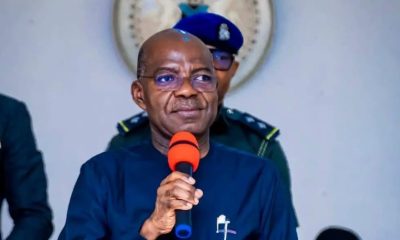
ShareAbia State Governor, Alex Otti has highlighted seven priority sectors and investment opportunities to drive industrialisation and economic development in...


DESTMA Receives 6,642 Applications for Recruitment, Warns Against Fraudsters
ShareFrom Francis Sadhere, Asaba No fewer than 6,642 Deltans have applied for recruitment into the Delta State Traffic Management Authority...

Alia Vows to Transform Benue Industrial Hub
ShareFrom Attah Ede, Makurdi Benue State Governor, Rev. Fr. Dr. Hyacinth Iormem Alia, has declared the Benue 2035 Economic Transformation,...
Redrawing the World Map: Cosmetic Fix or True Accuracy?
ShareBy Kayode Adebiyi For more than 400 years, the global view of geography has been quietly distorted by a 16th-century...