
NEWS
Rein in Your Members, CAN Warns Miyetti-Allah

By Mirian Gom, Abuja
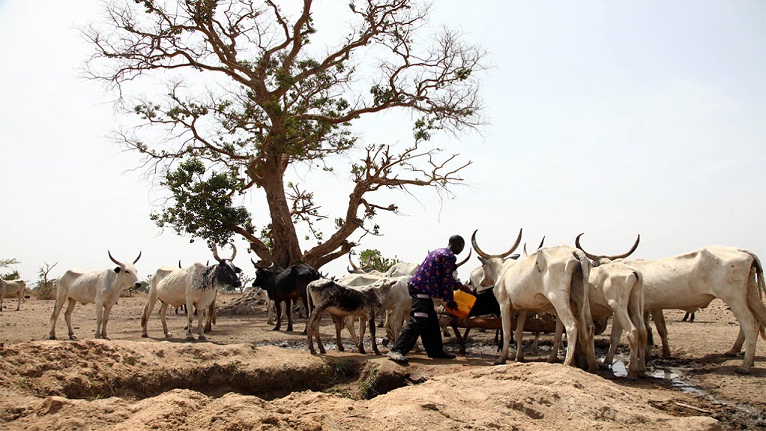
The Christian Association of Nigeria (CAN) has warned the leadership of the Miyetti-Allah Cattle Breeders Association of Nigeria (MACBAN) to call it’s violence-prone members to order.
The Christian body said until this is done, they cannot regain the trust and respect of Nigerians.
CAN President, Dr Samson Ayokunle, made the call at a news conference in Abuja.
He pointed out that until the Fulani began acting violently and killing innocent people, nobody hated them.
CAN said that if there was any enemy from any Fulani man, the Fulani man created the enemy for himself, as they have been living peacefully for many years in our various communities, till the killing issues started.
“In those days, our children married them, they married our children, but when they became too violent and started carrying AK47, killing people, what type of play is that? that’s a dangerous play.
“We can no longer think we are friends with that type of play it’s too dangerous, so let them call their people to order and ensure that they remove the enmity they have created around an average Fulani person,” he said.
Ayokunle challenged Fulani leaders to call the violent ones among them to order, as that is the only way people will respect them and trust them again.
He also charged the government to step up its security system across the country with a view to stopping the unending killings.





By David Torough, Abuja
Former member of the House of Representatives from Plateau State, Hon. Timothy Golu, has described the establishment of the North Central Development Commission (NCDC) and similar regional development commissions across Nigeria’s six geopolitical zones as one of the most significant developments in the country’s quest for balanced development.
Golu spoke on the sidelines of a stakeholders’ development summit with the theme, “The Great Leap Forward: A 20-Year Economic, Infrastructural and Social Development Plan for the North Central Region.
”According to the former federal lawmaker, the idea of regional development commissions gained prominence with the establishment of the North East Development Commission (NEDC), following a bill sponsored by the then Speaker of the House of Representatives, Rt.
Hon. Yakubu Dogara, in 2018.He said Dogara personally sponsored the bill in response to the devastating effects of insurgency and underdevelopment in the North East, adding that all 48 members representing the region in the National Assembly supported the initiative.
Golu noted that Dogara’s decision to personally sponsor the bill was unusual because it required him to temporarily step down from the Speaker’s chair and allow the Deputy Speaker to preside over proceedings.
“He had a passion for the North East because he saw that his zone was the most devastated at that time as a result of the activities of Boko Haram,” Golu explained.
He said the commission was conceived to give the region focused attention in areas including security, agriculture, infrastructure and economic development, with funding provided through deductions from the Federation Account in addition to the regular allocations accruing to the states.
However, Golu alleged that the bill suffered delays at the executive level for political reasons before it was eventually assented to by former President Muhammadu Buhari.
He attributed the eventual assent partly to interventions by then First Lady, Aisha Buhari, who, according to him, recognised the implications of allowing the North East to remain without the intervention mechanism.
The former lawmaker said the experience of the North East Development Commission inspired him to introduce a bill for the establishment of the North Central Development Commission.
Golu recalled that the North Central region was already experiencing worsening insecurity, particularly in Plateau, Benue, Taraba and parts of the Middle Belt, even before the scale of insecurity later witnessed in the North West.
“I was attracted, and we have similar problems with the North East. The banditry and insurgency were moving to the North Central,” he said.
He disclosed that he secured support from lawmakers across the North Central, irrespective of religious or political affiliation, but encountered resistance arising from tensions surrounding other legislative and constitutional issues at the time.
According to him, the development commission bill proposed by lawmakers from the South East had been rejected by the House shortly before he was scheduled to present the North Central bill.
Golu said the development led the then Speaker to advise him to withdraw his own bill temporarily to avoid suffering a similar fate.
“After talking to my colleagues, the then Minority Leader from Kogi State supported me, and I had taken all the suggestions and signatures from North Central, both Christians and Muslims. Everybody within the North Central was supporting the bill,” he recalled.
He said the establishment of development commissions for all six geopolitical zones eventually received greater political acceptance under the present administration, culminating in the passage and assent of the relevant legislation.
Golu stressed that the regional commissions represented more than development agencies, arguing that they could eventually become an important component of a broader restructuring of Nigeria’s political and administrative system.
According to him, the commissions could create a framework in which governance operates at four levels — local government, state, geopolitical zone and federal government.
“We now have four levels of government instead of three: you have the local government, the states, the zones and then the federal government,” he said.
He proposed that governors within each geopolitical zone could periodically elect a leader to coordinate regional affairs, while legislative structures at the regional level could provide oversight and representation.
Golu argued that such a system would enable issues peculiar to individual regions to be addressed closer to the people, while state and federal institutions would retain responsibility for matters within their respective jurisdictions.
He predicted that future constitutional amendments could further devolve powers from the federal government to the geopolitical zones and states.
“There will be a complete restructuring, while there will be exclusive items that only the federal government will do. There will be concurrent issues that both the zones, the federal and the state will do,” he said.
The former lawmaker described the establishment of the North Central Development Commission as timely, arguing that the commission would complement existing federal ministries and agencies by bringing development interventions closer to the people.
He said the impact of the North East Development Commission already offered an indication of what could be achieved through targeted regional intervention.
“They are just taking off,” Golu said when asked about measurable impacts of the commissions, noting that the North East commission had, however, recorded progress in employment generation, skills acquisition, agriculture and economic empowerment.
He described the intervention as an important non-kinetic approach to addressing insecurity, arguing that providing jobs, skills and economic opportunities could reduce the pool of unemployed young people vulnerable to recruitment by criminal and extremist groups.
“This is one of the non-kinetic measures of fighting insecurity. Those who would have been involved because they were jobless are now engaged,” he said.
Golu also cited the intervention in the Niger Delta as an example of how targeted regional development programmes could contribute to reducing insecurity.
He recalled that following the escalation of militancy in the Niger Delta, the administration of late President Umaru Musa Yar’Adua introduced an amnesty programme for militants and established the Ministry of Niger Delta Affairs, alongside other interventions.
According to him, the approach demonstrated that security operations alone cannot permanently resolve conflicts rooted in economic deprivation and underdevelopment.
He acknowledged concerns over the management of resources allocated to regional intervention agencies but maintained that effective leadership could turn the commissions into powerful engines of infrastructure, employment and economic development.
“If you have good people who manage well, you see the number of roads in the Niger Delta, at least there is an increase, and then the level of attention,” Golu said.
He therefore urged stakeholders in the North Central to take ownership of the NCDC and develop a long-term development agenda capable of transforming the region economically, socially and infrastructurally.
The former lawmaker said the proposed 20-year development plan for the North Central should serve as a roadmap for leveraging the commission to address the region’s infrastructure deficit, insecurity, unemployment, agricultural challenges and other structural impediments to development
A fire at a nursing home in Chile has killed 16 people, authorities said Saturday.
The blaze began on Friday night at the nursing home in the Araucania region, 640 kilometers (400 miles) south of the capital Santiago, and was extinguished in the early hours of Saturday.
Images shared on social media showed massive flames rising above the building in the darkness.
“We express our sorrow and dismay at the deaths of 16 elderly people in this tragedy,” authorities in the municipality of Pitrufquen said in a statement.
A total of 26 elderly residents were in the nursing home.
Ten of them survived and were taken to the local hospital, the statement said.Local mayor Jacqueline Romero said that municipal health and public safety teams, firefighters and police were deployed in response to the blaze.
“It is a situation that fills our souls with great sorrow and pain. We have been… providing support to the families,” she said.
The cause of the fire remained unclear.
“We are currently carrying out investigative procedures, including examining the scene and conducting inquiries, to determine the origin and cause of the fire, as well as to rule out third-party involvement,” Jorge Granada, the prosecutor assigned to the case, told local media.

By Tambaya Julius, Abuja
The Association of South-East Igbo Winds has thrown its weight behind the All Progressives Congress (APC), promised aggressive grassroots mobilisation across the 11 electoral wards of Karu Local Government Area of Nasarawa State ahead of the 2027 general elections.
The group made its position known during an engagement with the APC candidate for Karu/Gitata Constituency in the Nasarawa State House of Assembly, Dr.
Abraham Habu Ekpo, on Saturday in Mararaba, where members described him as a credible, dependable and people-oriented politician capable of providing effective representation.The association said Ekpo’s character, credibility and direct engagement with residents had strengthened its confidence in his candidacy, declaring its readiness to mobilise support for him and other APC candidates across the council.
Speaking during the engagement, Ekpo thanked the group for its support and commitment to the APC, saying his decision to contest on the party’s platform was informed by his belief in its progressive ideals and development-oriented agenda.
“Progress is about propelling growth, bringing development, advancing the cause of humanity and giving it dignity. That is why we are part of the progressives,” he said.
Ekpo said his ambition was driven by a desire to contribute to the development of Karu and promote policies that would place the people at the centre of governance.
“My ambition was driven by a desire to contribute to the development of Karu and promote a government that places people at the centre of its policies,” he said.
The candidate also promised to pursue greater inclusion for residents who have lived, worked and contributed to the economic growth of Karu, irrespective of their states of origin.
According to him, people who make meaningful contributions to the development of a community deserve a sense of belonging and should not be treated as outsiders.
He said inclusion would form a key part of his legislative agenda if elected into the Nasarawa State House of Assembly in 2027.
Ekpo further canvassed support for the APC, arguing that the Nasarawa State Government under the party had recorded achievements in infrastructure, road construction and peace-building across the state.
He cited the ongoing flyover project in Mararaba among projects he said the APC could showcase to voters as evidence of its development agenda.
The APC candidate also stressed the importance of sustaining the relative peace in the state, saying a peaceful environment was necessary for economic growth, investment and meaningful development.
He urged residents of Karu to support the APC and its candidates in the 2027 elections.
Members of the Igbo association expressed confidence in Ekpo, describing him as a politician whose character, credibility and dependability had earned their trust.
They commended him for engaging directly with the members, saying the interaction had further strengthened their resolve to support his political ambition.
The group declared that its commitment would extend beyond verbal support, promising coordinated mobilisation across the 11 electoral wards of Karu.
“In all these 11 wards, we are prepared and ready to follow the APC. We are ready to support you and all other candidates going forward,” the members declared.




North Central Devt Commission ‘ll Drive Regional Transformation, Restructuring – Golu
ShareBy David Torough, Abuja Former member of the House of Representatives from Plateau State, Hon. Timothy Golu, has described the...
Fire at Nursing Home in Chile Kills 16
ShareA fire at a nursing home in Chile has killed 16 people, authorities said Saturday. The blaze began on Friday...
Yazeed Al Rajhi Returns to Baja Aragon with Dennis Zenz
ShareSaudi Arabian World Champion Yazeed bin Mohammed Al-Rajhi is set to resume competition at Baja Espana Aragon 2026 following its...


Trump Turns to Golf, Family Business on Irish Visit’s Second Day
ShareDonald Trump turns his focus Sunday to golf and promoting his business interests, as he wraps up a two-day visit...
Legendary Canadian Boxer George Chuvalo Dies at 89
ShareCanadian boxer George Chuvalo, a five-time national heavyweight champion, has died at the age of 89. Out of 93 total...


Antonelli Wins as Norris Loses out Under Virtual Safety Car
ShareMercedes driver Kimi Antonelli won the Spanish Grand Prix after McLaren’s Lando Norris lost out because of the bad timing...
Andy Burnham among Great North Run finishers
ShareThe Great North Run (GNR) returned to Tyneside this weekend, with 63,000 runners taking part in the world’s biggest half...


Serena Reflects On First Pregnancy
ShareVeteran US tennis star Serena Williams has disclosed that being heard by medical professionals after experiencing life-threatening childbirth complications literally...


Group Backs Dr. Ekpo, Vows Ward-by-Ward Campaign for APC in Karu
ShareBy Tambaya Julius, Abuja The Association of South-East Igbo Winds has thrown its weight behind the All Progressives Congress (APC),...
Nigeria Begins Local Production of Dual-active Mosquito Nets, Targets 10m Annually
ShareNigeria has commenced local production of next-generation dual-active ingredient insecticide-treated mosquito nets to strengthen malaria prevention and domestic manufacturing. The...